What is Event-Driven Architecture (EDA)?
Understanding the Foundation of Modern Real-Time Systems
Modern applications are expected to respond instantly, scale globally, and process enormous volumes of data in real time. Whether it is a payment notification arriving immediately after a transaction, a fraud alert triggered within milliseconds, or a ride-sharing app updating driver locations continuously, traditional system architectures often struggle to meet these expectations efficiently.
This is where Event-Driven Architecture (EDA) becomes important.
EDA has become one of the foundational architectural styles behind modern distributed systems, cloud-native applications, microservices, and real-time analytics platforms. Technologies like Apache Kafka, RabbitMQ, Pulsar, and cloud-native messaging systems have accelerated the adoption of event-driven systems across industries.
In this article, we will understand:
- What Event-Driven Architecture is
- Why traditional systems face limitations
- How EDA solves scalability and responsiveness problems
- Core components of an event-driven system
- Real-world examples
- The lifecycle of an event
- Why Kafka is commonly used in EDA systems
This article serves as the gateway to the entire Kafka and Event-Driven Systems tutorial series.
Understanding Traditional Request-Response Systems
Before understanding EDA, it is important to understand how traditional applications typically communicate.
Most conventional systems use a request-response architecture.
In this model:
- A client sends a request
- The server processes the request
- The server returns a response
- The client waits until processing completes
For example:
User → Payment Service → Database → Response
A typical payment API might behave like this:
POST /makePayment
The server:
- validates the request
- checks account balance
- processes payment
- updates database
- sends confirmation
- returns response
The client waits during the entire operation.
Problems with Traditional Architectures
Request-response systems work well for many applications, but they begin to struggle when systems become:
- highly distributed
- real-time
- traffic-intensive
- independently scalable
- integrated with many services
Common Challenges
1. Tight Coupling
Services become directly dependent on each other.
Example:
Payment Service → Notification Service
Payment Service → Fraud Service
Payment Service → Analytics Service
If one service fails or becomes slow, the entire workflow may be impacted.
2. Scalability Bottlenecks
As traffic grows:
- APIs become overloaded
- databases become bottlenecks
- synchronous calls increase latency
Scaling becomes increasingly difficult.
3. Poor Fault Isolation
If one downstream service crashes:
- requests may fail entirely
- retry storms may occur
- cascading failures can spread across the system
4. Limited Real-Time Responsiveness
Traditional architectures often struggle with:
- real-time dashboards
- live analytics
- instant notifications
- streaming pipelines
What is Event-Driven Architecture?
Event-Driven Architecture is a software architecture pattern where systems communicate through events rather than direct synchronous requests.
An event represents:
“Something important happened.”
Examples:
PaymentCompleted
OrderPlaced
DriverAssigned
InventoryUpdated
FraudDetected
Instead of directly calling another service, systems publish events that other services can react to independently.
Simple EDA Analogy
Imagine a news broadcasting station.
- The broadcaster publishes news
- Multiple viewers receive it
- The broadcaster does not know who is watching
- Viewers consume information independently
EDA works similarly.
A producer publishes events.
Consumers independently react to those events.
Core Components of Event-Driven Architecture
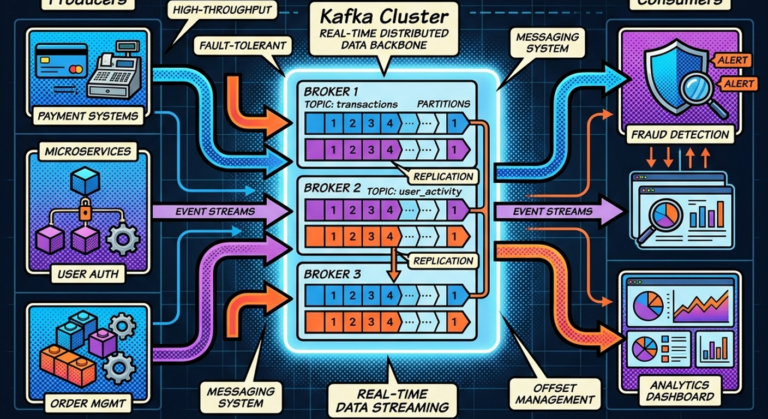
EDA systems usually contain three primary components.
1. Producers
Producers generate events.
Examples:
- payment systems
- mobile apps
- e-commerce platforms
- IoT devices
A producer does not care who consumes the event.
It simply publishes information.
Example event:
{
  "eventType": "PaymentCompleted",
  "transactionId": "TXN10293",
  "amount": 2500,
  "timestamp": "2026-05-25T10:30:00Z"
}
2. Event Brokers
The broker acts as the central event distribution system.
Its responsibilities include:
- receiving events
- storing events
- distributing events
- handling scalability
- managing ordering and durability
Popular event brokers:
- Apache Kafka
- RabbitMQ
- Pulsar
- AWS Kinesis
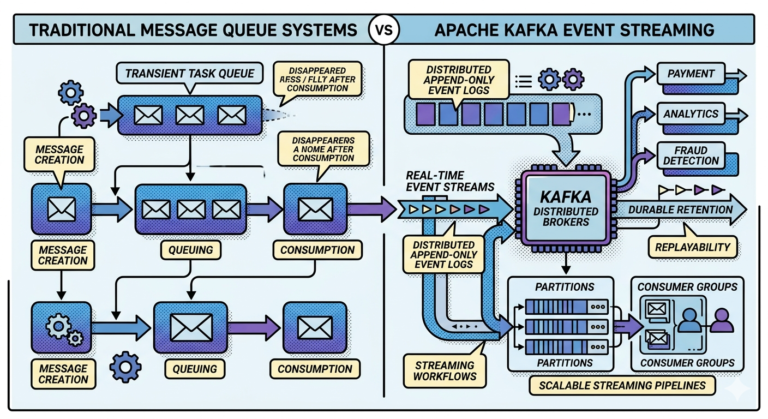
Kafka is particularly popular because it combines:
- messaging
- storage
- stream processing
- scalability
- fault tolerance
3. Consumers
Consumers subscribe to events and react independently.
Examples:
- fraud detection service
- notification service
- analytics engine
- reporting systems
One event can trigger many independent consumers simultaneously.
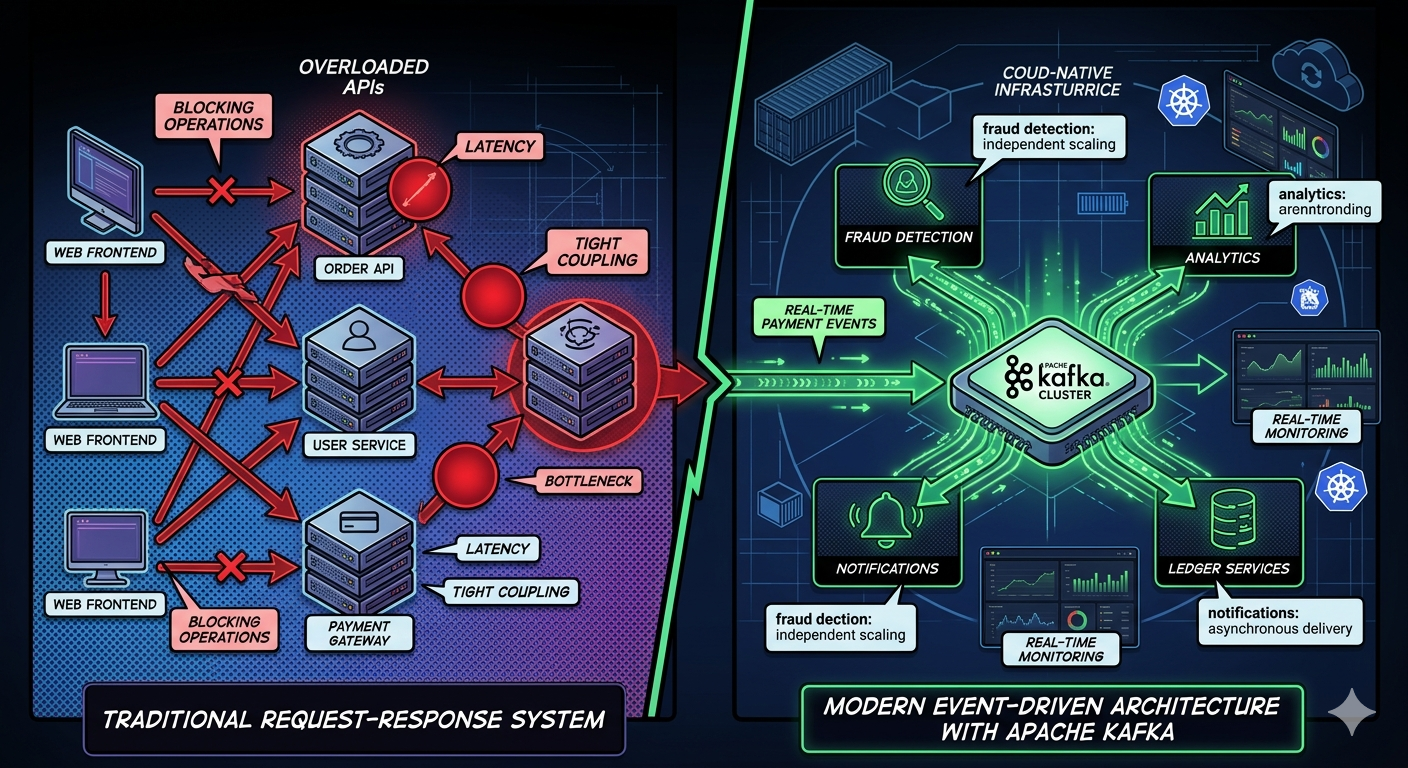
Real-World Example — Payment Processing System
Let us consider a payment processing platform.
Traditional Flow
User
  ↓
Payment Service
  ├── Fraud Service
  ├── Notification Service
  ├── Ledger Service
  └── Analytics Service
Problems:
- tight coupling
- high latency
- failure propagation
- difficult scaling
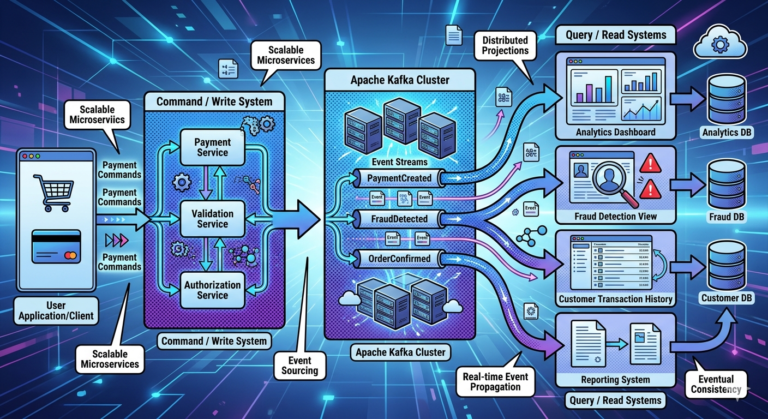
Event-Driven Flow
Payment Service
      ↓
PaymentCompleted Event
      ↓
Kafka Topic
 ├── Fraud Detection Service
 ├── Notification Service
 ├── Analytics Service
 └── Ledger Service
Advantages:
- services become independent
- easier scaling
- asynchronous processing
- better fault isolation
- higher throughput
Why Modern Systems Moved Toward Events
Modern applications require:
- massive scalability
- real-time responsiveness
- distributed processing
- independent deployments
- resilience
EDA solves many of these challenges naturally.
Real-World Industry Examples
1. Payment Systems
Banks and fintech platforms use events for:
- transaction processing
- fraud analysis
- audit trails
- notifications
Every transaction becomes an event stream.
2. Ride-Sharing Applications
Apps like Uber continuously generate:
- driver location events
- ride request events
- payment events
- surge pricing events
Thousands of events occur every second.
3. E-Commerce Platforms
Online stores generate:
- order placed events
- inventory updates
- shipment tracking
- recommendation updates
One customer action may trigger dozens of downstream workflows.
4. Fraud Detection Systems
Fraud engines consume transaction streams in real time.
They analyze:
- transaction velocity
- geographic anomalies
- unusual spending patterns
- suspicious behaviors
All powered by continuous event streams.
Understanding the Event Lifecycle
An event typically follows this lifecycle:
Step 1 — Event Creation
A business action occurs.
Example:
Customer makes payment
Step 2 — Event Publishing
The producer publishes an event.
PaymentCompleted
Step 3 — Broker Receives Event
Kafka stores the event inside a topic partition.
Step 4 — Event Distribution
Consumers subscribed to the topic receive the event.
Step 5 — Independent Processing
Each consumer performs its own task:
- Fraud service validates transaction
- Notification service sends SMS/email
- Analytics service updates dashboards
- Ledger service records accounting entry
All independently.
EDA Enables Loose Coupling
One of the biggest advantages of EDA is loose coupling.
The producer:
- does not know consumers
- does not wait for consumers
- does not depend on consumer availability
This dramatically improves:
- scalability
- reliability
- maintainability
Event-Driven Architecture and Microservices
EDA is commonly combined with microservices.
Why?
Because microservices naturally benefit from:
- independent communication
- asynchronous workflows
- isolated deployments
- event-based integration
Kafka often becomes the “central nervous system” connecting microservices.
Challenges in Event-Driven Systems
EDA is powerful, but it introduces new complexities.
1. Event Ordering
In distributed systems, ordering can become difficult.
Example:
PaymentCompleted
PaymentRefunded
What happens if events arrive out of order?
2. Duplicate Events
Systems must often handle duplicate message delivery safely.
3. Event Schema Evolution
Event structures change over time.
Managing compatibility becomes critical.
4. Debugging Complexity
Tracing workflows across asynchronous systems is harder than tracing API calls.
Why Kafka Became the Industry Standard
Apache Kafka became highly popular because it solves many EDA challenges effectively.
Kafka provides:
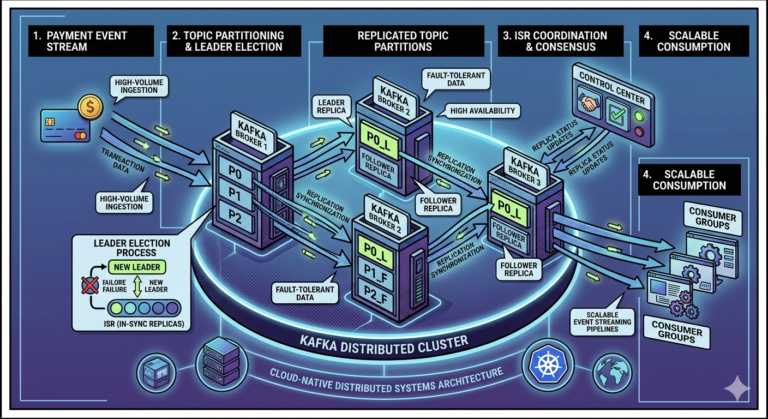
- durable event storage
- horizontal scalability
- partitioned processing
- high throughput
- replay capability
- fault tolerance
- consumer scalability
Kafka is now widely used in:
- fintech
- streaming platforms
- e-commerce
- IoT
- cybersecurity
- observability systems
Key Takeaways
Event-Driven Architecture enables systems to become:
- scalable
- loosely coupled
- asynchronous
- resilient
- real-time capable
Instead of services directly calling each other, systems communicate using events.
This architectural style powers many modern platforms including:
- payment systems
- ride-sharing apps
- fraud detection engines
- real-time analytics platforms
And technologies like Apache Kafka make building these systems practical at scale.