Event-Driven Workflows Explained Using a Payment System
Understanding Real-World Event Orchestration with Kafka
One of the biggest reasons organizations adopt:
Apache Kafka
is to build:
Event-driven workflows.
Modern business systems rarely consist of a single isolated action.
A simple customer payment may trigger:
- fraud detection
- notifications
- inventory updates
- accounting entries
- analytics pipelines
- shipping workflows
Traditional synchronous architectures struggle to coordinate such workflows efficiently at scale.
Event-driven workflows solve this problem by enabling:
- asynchronous coordination
- loosely coupled services
- scalable processing
- real-time responsiveness
In this article, we will deeply explore:
- what event-driven workflows are
- how workflows evolve through events
- orchestration vs choreography
- asynchronous workflow execution
- Kafka-based workflow design
- real-world payment processing examples
- retries and failures
- workflow observability
- scalability benefits
This article connects Kafka fundamentals to real enterprise system architecture.
What is an Event-Driven Workflow?
An event-driven workflow is:
A sequence of business activities triggered and coordinated through events.
Instead of:
- directly calling downstream services
systems:
- publish events
- react asynchronously
- continue workflows independently
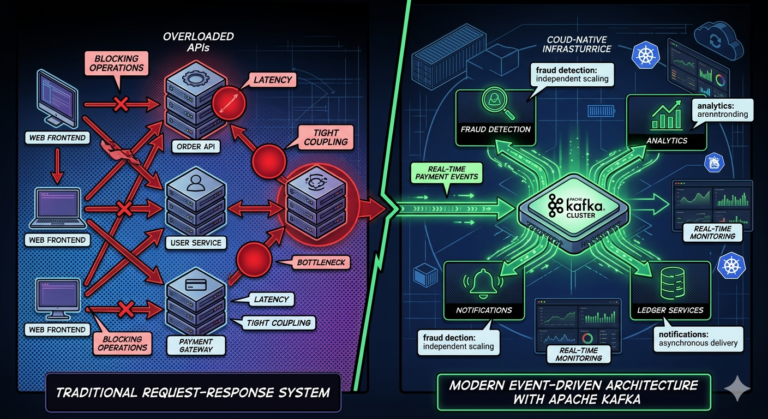
Traditional Workflow Example
Suppose payment service processes an order.
Traditional architecture:
Payment Service
   ├── Fraud Service
   ├── Notification Service
   ├── Ledger Service
   └── Analytics Service
The payment service becomes tightly coupled to:
- multiple downstream systems
- synchronous dependencies
- cascading failures
This architecture becomes difficult to scale.
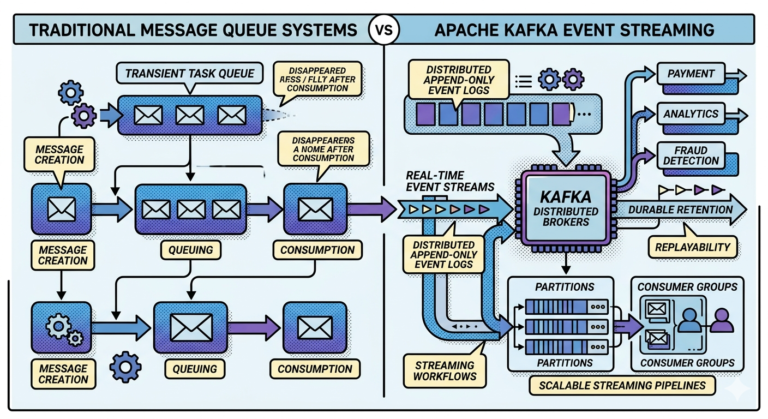
Event-Driven Workflow Example
Now consider event-driven architecture:
Payment Service
      ↓
PaymentCompleted Event
      ↓
Kafka Topic
 ├── Fraud Detection
 ├── Notification Service
 ├── Ledger Service
 └── Analytics Service
The payment service simply publishes:
PaymentCompleted
Everything else reacts independently.
This is event-driven workflow orchestration.
Why Event-Driven Workflows Matter
Modern systems require:
- scalability
- asynchronous processing
- resilience
- independent deployments
- real-time processing
Event-driven workflows naturally support these goals.
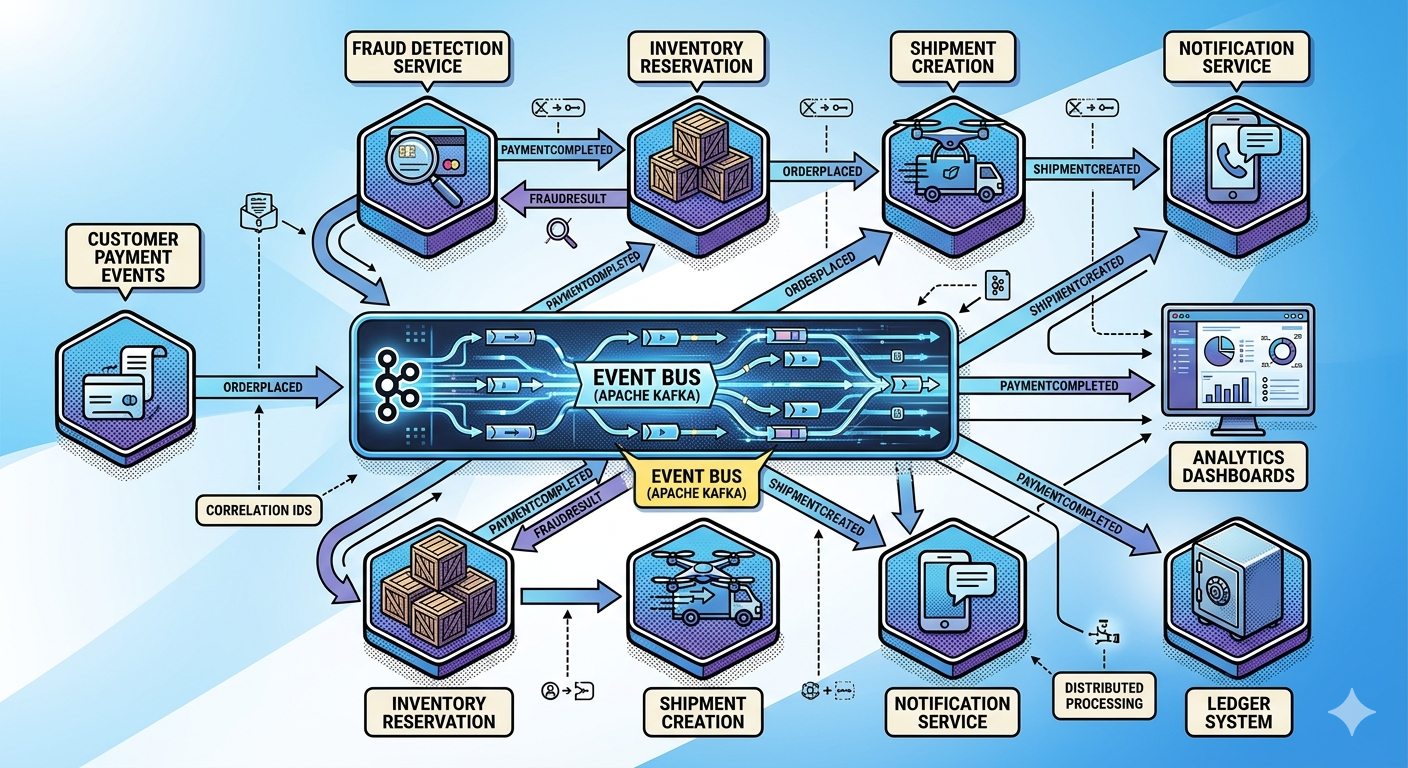
Real-World Payment Workflow
Let us follow a realistic payment transaction.
Customer places an order.
This single action triggers multiple workflows.
Step 1 — Order Created
Customer submits checkout.
System generates:
OrderPlaced
Event published into Kafka.
Step 2 — Payment Processing Begins
Payment service consumes:
OrderPlaced
Processes payment gateway interaction.
If successful:
PaymentCompleted
published to Kafka.
Step 3 — Fraud Detection Triggers
Fraud detection service subscribes to:
payments topic
Consumes:
PaymentCompleted
Performs:
- risk scoring
- anomaly detection
- behavioral analysis
If suspicious:
FraudDetected
event generated.
Step 4 — Notification Workflow
Notification service independently consumes:
PaymentCompleted
Sends:
- SMS
- push notifications
No direct dependency on payment service.
Step 5 — Inventory Workflow
Inventory system consumes:
OrderPlaced
Reserves stock.
Publishes:
InventoryReserved
Step 6 — Shipping Workflow
Logistics service consumes:
InventoryReserved
Creates shipment.
Publishes:
ShipmentCreated
Step 7 — Analytics Workflow
Analytics systems continuously consume:
- payments
- orders
- shipments
- fraud events
Dashboards update in real time.
Important Observation
Notice something critical:
No central system directly controls the entire workflow.
Instead:
- events coordinate workflow progression
This creates:
- loose coupling
- scalability
- extensibility
Workflow Choreography vs Orchestration
This introduces two important workflow models.
1. Orchestration
In orchestration:
- one central service controls workflow
Example:
Workflow Engine
   ├── Call Payment Service
   ├── Call Inventory Service
   ├── Call Shipping Service
Centralized control.
Problems with Orchestration
As systems grow:
- orchestrators become bottlenecks
- workflows become rigid
- scaling becomes difficult
2. Choreography
Event-driven systems often use:
Choreography.
Services react independently to events.
Example:
OrderPlaced
   ↓
Payment Service reacts
   ↓
PaymentCompleted
   ↓
Inventory Service reacts
No central controller required.
Why Kafka Enables Choreography
Kafka topics act as:
- shared event streams
- coordination channels
Services simply:
- publish events
- subscribe to relevant events
This naturally enables choreography-based workflows.
Benefits of Event-Driven Workflows
1. Loose Coupling
Services do not directly depend on each other.
This improves:
- maintainability
- flexibility
- deployment independence
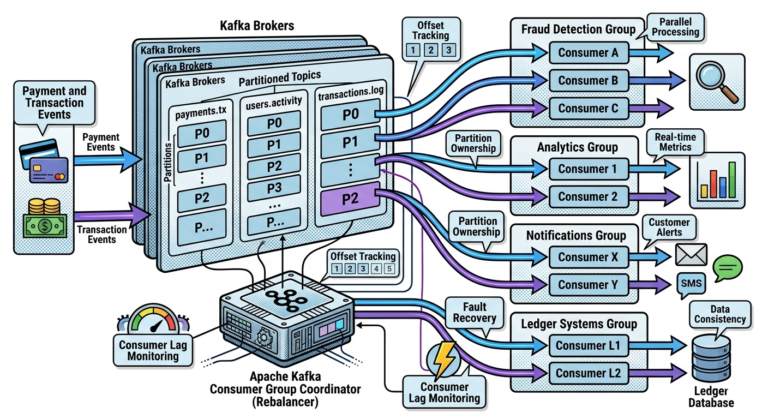
2. Scalability
Each service scales independently.
Example:
Fraud Detection
→ Scale to 20 consumers

Notification Service
→ Scale to 5 consumers
No impact on payment service.
3. Fault Isolation
Suppose:
- notification service crashes
Payment processing continues normally.
Kafka retains events until recovery.
4. Real-Time Responsiveness
Events propagate instantly through workflows.
This enables:
- live analytics
- real-time fraud detection
- instant notifications
5. Extensibility
New services can subscribe anytime.
Example:
- loyalty system added later
- simply consumes payment events
No changes required in producers.
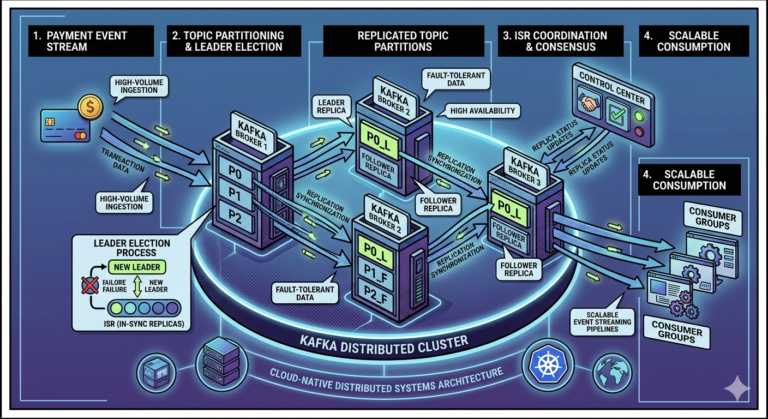
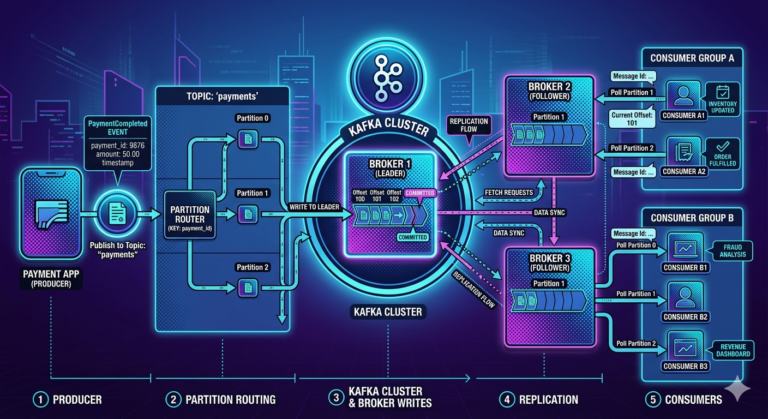
Kafka as the Workflow Backbone
Apache Kafka acts as:
The event backbone coordinating workflows.
Kafka provides:
- durable event storage
- asynchronous communication
- replayability
- scalable distribution
- partitioned parallelism
This makes Kafka ideal for workflow-driven architectures.
Understanding Workflow State
One challenge in event-driven workflows:
State management.
Suppose workflow spans:
- payment
- inventory
- shipment
- delivery
Where does overall workflow state live?
Common State Approaches
Organizations often use:
- workflow state databases
- event sourcing
- stream processing
- saga patterns
Managing distributed state becomes an advanced architectural concern.
The Saga Pattern
Event-driven systems commonly use:
Saga patterns.
A saga coordinates distributed workflows through events.
Example:
OrderPlaced
   ↓
PaymentCompleted
   ↓
InventoryReserved
   ↓
ShipmentCreated
Each step publishes new events.
Compensating Actions
Suppose:
- shipment creation fails
Workflow may generate:
InventoryReleased
PaymentRefunded
These are called:
Compensating transactions.
Critical in distributed workflows.
Why Distributed Transactions Are Difficult
Traditional databases support:
- ACID transactions
Distributed event-driven workflows span:
- multiple services
- multiple databases
- asynchronous systems
Global transactions become impractical.
This is why:
- eventual consistency
- compensating workflows
become important.
Eventual Consistency in Workflows
Event-driven systems often achieve:
Eventual consistency.
Meaning:
- systems become consistent over time
- asynchronously
This is acceptable in many real-world systems.
Example
Immediately after payment:
- shipment may not yet exist
- inventory update may still process
Eventually:
- all systems synchronize correctly
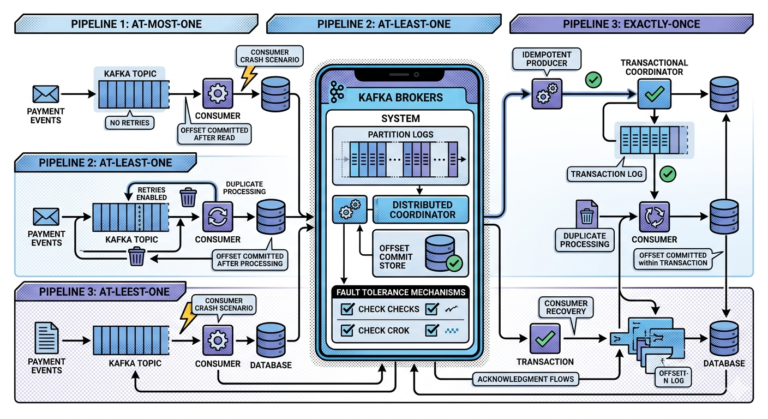
Workflow Failures in Kafka Systems
Failures are normal in distributed systems.
Examples:
- consumer crashes
- network interruptions
- processing errors
Kafka helps by:
- retaining events
- enabling retries
- supporting replayability
Retry Workflows
Suppose notification service fails.
Kafka still retains:
PaymentCompleted
Consumer retries later.
This improves resilience dramatically.
Dead Letter Queues (DLQ)
If processing repeatedly fails:
Poison Message
can move to:
Dead Letter Queue.
DLQs isolate problematic events safely.
Workflow Observability
Event-driven workflows require strong observability.
Teams monitor:
- event lag
- consumer health
- workflow latency
- retries
- failures
Tools often include:
- Grafana
- Prometheus
- distributed tracing systems
Why Correlation IDs Matter
Workflows span multiple events.
Correlation IDs help trace:
OrderPlaced
PaymentCompleted
ShipmentCreated
as part of:
- one business transaction
Critical for debugging distributed workflows.
Real-World Example — Ride Sharing
Ride-sharing platforms use event-driven workflows extensively.
Example workflow:
RideRequested
   ↓
DriverAssigned
   ↓
RideStarted
   ↓
PaymentCompleted
Each stage coordinated through events.
Real-World Example — Banking
Banking systems process:
- transfers
- fraud analysis
- notifications
- compliance checks
- audit logging
through event-driven workflows.
Kafka is heavily used in such architectures.
Why Event-Driven Workflows Became Popular
Modern systems require:
- scalability
- resilience
- asynchronous communication
- independent services
- distributed processing
Event-driven workflows naturally satisfy these needs.
Common Beginner Misconceptions
Misconception 1
Kafka itself executes workflows
Kafka coordinates event flow.
Applications implement workflow logic.
Misconception 2
Event-driven workflows are always simpler
They improve scalability but introduce distributed complexity.
Misconception 3
Failures disappear in event-driven systems
Failures still happen.
Architectures must handle retries and compensation.
Misconception 4
Synchronous APIs are obsolete
Most systems combine:
- APIs for interaction
- events for backend workflows
Why This Architecture Is So Powerful
Event-driven workflows allow organizations to build:
- scalable payment systems
- real-time fraud detection
- streaming analytics
- resilient microservices ecosystems
using:
Apache Kafka
as the central coordination backbone.
Key Takeaways
Event-driven workflows coordinate business processes through:
- asynchronous events
- loosely coupled services
- distributed processing
Kafka topics act as:
- workflow communication channels
Services react independently to events such as:
- OrderPlaced
- PaymentCompleted
- InventoryReserved
- ShipmentCreated
This architecture enables:
- scalability
- resilience
- extensibility
- real-time processing
Modern distributed systems increasingly rely on:
- event choreography
- asynchronous coordination
- Kafka-based event streaming
to power complex enterprise workflows.