Kafka Delivery Guarantees Explained Simply
Understanding At-Most-Once, At-Least-Once, and Exactly-Once Processing
One of the most important concepts in:
Apache Kafka
is:
Delivery guarantees.
Whenever Kafka processes events, an important question arises:
What happens if failures occur?
For example:
- What if the consumer crashes?
- What if the broker fails?
- What if acknowledgment packets are lost?
- What if a producer retries sending a message?
Can messages:
- disappear?
- duplicate?
- process multiple times?
The answer depends on:
Kafka delivery semantics.
Understanding delivery guarantees is essential because they directly affect:
- reliability
- correctness
- fault tolerance
- financial safety
- system consistency
In this article, we will clearly and simply explain:
- at-most-once delivery
- at-least-once delivery
- exactly-once delivery
- message loss
- duplicate processing
- retries
- practical tradeoffs
- real-world examples
This article builds the conceptual foundation for reliable Kafka systems.
Why Delivery Guarantees Matter
Imagine a payment processing system.
A customer completes a ₹5000 transaction.
Kafka publishes:
{
  "eventType": "PaymentCompleted",
  "transactionId": "TXN9001",
  "amount": 5000
}
Now imagine different failure scenarios:
Scenario 1 — Message Lost
Fraud detection never sees the transaction.
Dangerous.
Scenario 2 — Message Processed Twice
Customer receives:
- duplicate SMS
- duplicate invoice
- double account credit
Also dangerous.
Scenario 3 — Processed Exactly Once
System behaves correctly.
Ideal outcome.
Distributed Systems Are Unreliable
Modern systems are distributed.
Distributed systems constantly face:
- network failures
- broker crashes
- application restarts
- timeout issues
- packet loss
- retries
Kafka must decide:
How should failures be handled?
This leads to different delivery guarantees.
The Three Delivery Guarantees
Kafka supports three primary delivery models:
- At-most-once
- At-least-once
- Exactly-once
Each involves tradeoffs.
There is no perfect free solution.
Understanding the Core Challenge
The challenge comes from this sequence:
Read Event
   ↓
Process Event
   ↓
Acknowledge Processing
What happens if crash occurs:
- in the middle?
- before acknowledgment?
- after processing?
- during retry?
Different handling strategies create different guarantees.
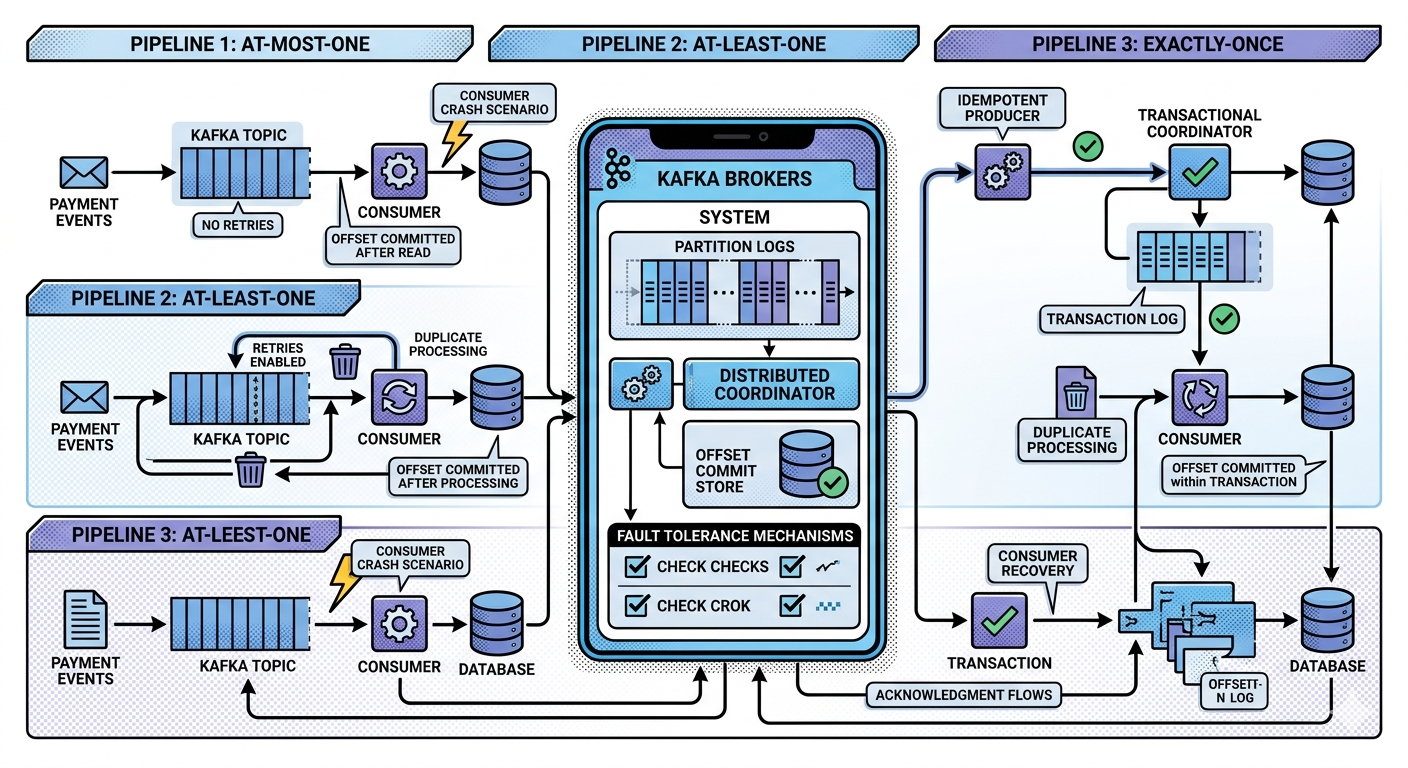
1. At-Most-Once Delivery
At-most-once means:
Messages are delivered zero or one time.
Duplicates are avoided.
But message loss is possible.
Simple Mental Model
Better to lose message
than process twice
How At-Most-Once Works
Consumer commits offset:
- before processing
Example:
Read Event
   ↓
Commit Offset
   ↓
Process Event
Failure Scenario
Suppose:
Offset committed
Consumer crashes before processing
Result:
- Kafka believes message already handled
- message disappears forever
Message lost.
Real-World Example
Suppose notification system receives:
PaymentCompleted
Consumer crashes before sending SMS.
Kafka already marked message complete.
Customer never receives notification.
Advantages of At-Most-Once
Advantages:
- simple
- fast
- no duplicate processing
- lower overhead
Disadvantages of At-Most-Once
Disadvantages:
- message loss possible
- unreliable for critical systems
Suitable Use Cases
At-most-once works for:
- monitoring metrics
- telemetry
- analytics sampling
- non-critical logging
Not suitable for:
- banking
- payments
- inventory management
2. At-Least-Once Delivery
At-least-once means:
Messages are never lost,
but may be processed multiple times.
This is Kafka’s most common model.
Simple Mental Model
Better to process twice
than lose important data
How At-Least-Once Works
Consumer:
- processes event first
- commits offset afterward
Example:
Read Event
   ↓
Process Event
   ↓
Commit Offset
Failure Scenario
Suppose:
Event processed successfully
Consumer crashes before committing offset
After restart:
- Kafka re-delivers same event
Result:
- duplicate processing
Real-World Example
Suppose customer payment triggers SMS.
Consumer:
- sends SMS successfully
- crashes before offset commit
Kafka retries event.
Customer receives:
- duplicate SMS notification
Why Kafka Prefers Duplicates
Kafka intentionally prefers:
Duplicate delivery over message loss.
Because:
- duplicates can often be handled
- lost financial transactions are unacceptable
This philosophy is extremely important.
Advantages of At-Least-Once
Advantages:
- strong reliability
- no message loss
- highly practical
- production-friendly
Disadvantages of At-Least-Once
Disadvantages:
- duplicate processing possible
- applications must handle retries safely
Suitable Use Cases
At-least-once is widely used for:
- payments
- orders
- fraud detection
- inventory systems
- event sourcing
This is the most common enterprise choice.
3. Exactly-Once Delivery
Exactly-once means:
Messages affect system state only once.
No logical duplicates.
No message loss.
This is the most difficult model.
Important Clarification
Exactly-once does NOT literally mean:
- packet delivered only once
Instead it means:
- final outcome remains correct exactly once
This distinction matters enormously.
Why Exactly-Once is Hard
Suppose workflow:
Process Payment
   ↓
Update Database
   ↓
Commit Offset
What if crash occurs:
- after DB update
- before offset commit?
Kafka may re-deliver event.
Without safeguards:
- duplicate processing occurs
Kafka’s Exactly-Once Features
Kafka introduced:
- idempotent producers
- transactions
- atomic offset coordination
to support exactly-once semantics.
Understanding Idempotency
Idempotency means:
Repeating operation
does not change final result
Example:
Set account status = ACTIVE
Running repeatedly:
- remains safe
Non-Idempotent Example
Add ₹5000 to balance
Running twice:
- corrupts financial data
Why Idempotency Matters
Many real-world systems combine:
- at-least-once delivery
- idempotent consumers
This achieves highly reliable behavior.
Understanding the Tradeoffs
No delivery guarantee is universally perfect.
Each involves tradeoffs.
Comparison Table
| Delivery Model | Message Loss | Duplicate Risk | Complexity |
|—|—|—|
| At-most-once | Possible | No | Low |
| At-least-once | No | Possible | Medium |
| Exactly-once | Controlled | Controlled | High |
Real-World Industry Preference
Most production Kafka systems use:
At-Least-Once + Idempotency
because it provides:
- strong reliability
- operational simplicity
- excellent scalability
Why Exactly-Once Is Not Always Necessary
Many systems tolerate occasional duplicates.
Examples:
- duplicate emails
- duplicate analytics counts
- repeated notifications
But losing data may be catastrophic.
Thus:
- at-least-once often becomes ideal.
Payment System Example
Suppose payment event:
{
  "transactionId": "TXN9001"
}
Consumer checks:
- has this transaction already been processed?
If yes:
- skip duplicate safely
This is practical idempotency.
Delivery Guarantees and Producers
Producers also affect delivery guarantees.
Kafka producer settings like:
acks=0
acks=1
acks=all
control:
- reliability
- acknowledgment behavior
- durability guarantees
Delivery Guarantees and Consumers
Consumers influence guarantees through:
- offset commit timing
- retry handling
- processing logic
- idempotency implementation
Reliable systems require both:
- reliable producers
- reliable consumers
Delivery Guarantees Are Business Decisions
Choosing delivery semantics depends on:
- business requirements
- operational cost
- acceptable risk
- latency tolerance
Example:
| System | Preferred Guarantee |
|---|---|
| Metrics Dashboard | At-most-once |
| Payment Platform | At-least-once |
| Financial Ledger | Exactly-once or Idempotent |
| Notification System | At-least-once |
Why Kafka Delivery Semantics Matter So Much
Delivery guarantees affect:
- customer trust
- financial correctness
- operational stability
- distributed system reliability
Misunderstanding delivery semantics can create:
- duplicate charges
- missing transactions
- corrupted analytics
- inconsistent state
This is why Kafka engineers must understand them deeply.
Common Beginner Misconceptions
Misconception 1
Kafka automatically guarantees exactly-once everywhere
Not true.
Application design matters significantly.
Misconception 2
Duplicates mean Kafka failed
Duplicates are often intentional safety behavior.
Misconception 3
At-most-once is safer
Message loss may be far more dangerous.
Misconception 4
Exactly-once has no tradeoffs
EOS introduces complexity and overhead.
Real-World Engineering Reality
Most reliable Kafka systems combine:
- at-least-once delivery
- idempotent processing
- retry handling
- deduplication logic
This balance works extremely well in practice.
Key Takeaways
Kafka supports three primary delivery guarantees:
| Guarantee | Characteristics |
|---|---|
| At-most-once | No duplicates, but possible message loss |
| At-least-once | No message loss, but duplicates possible |
| Exactly-once | Prevents logical duplicates with additional coordination |
Kafka intentionally prioritizes:
Reliability over perfect simplicity.
In real-world distributed systems:
- duplicates are often manageable
- lost data is often unacceptable
This is why:
- at-least-once delivery
- combined with idempotent processing
is one of the most common strategies used with:
Apache Kafka
for building scalable and reliable event-driven systems.