Exactly Once Processing in Kafka — Myth vs Reality
Understanding Kafka Delivery Semantics, Idempotency, and the Truth About Duplicate-Free Processing
One of the most misunderstood topics in:
Apache Kafka
is:
Exactly-once processing.
At first glance, the idea sounds simple:
Every event is processed exactly once.
No duplicates.
No data loss.
Perfect consistency.
But in distributed systems, things are never that simple.
Networks fail.
Consumers crash.
Retries happen.
Partitions rebalance.
Acknowledgments get lost.
And suddenly:
- duplicate processing appears
- offsets become inconsistent
- transactions partially complete
This is why exactly-once processing is considered one of the hardest problems in distributed systems.
In this article, we will deeply explore:
- Kafka delivery semantics
- why duplicates happen
- at-most-once delivery
- at-least-once delivery
- exactly-once semantics (EOS)
- idempotent producers
- Kafka transactions
- consumer offset coordination
- practical limitations
- real-world tradeoffs
This is one of the most important operational concepts in Kafka engineering.
Why Delivery Semantics Matter
Imagine a payment processing system.
Suppose this event exists:
{
  "eventType": "PaymentCompleted",
  "transactionId": "TXN5001",
  "amount": 2500
}
Now imagine it gets processed:
- once by ledger service
- twice by notification service
- zero times by fraud detection
This creates:
- inconsistent systems
- financial corruption
- duplicate notifications
- operational chaos
Delivery guarantees exist to control these risks.
Understanding the Core Problem
Distributed systems are unreliable by nature.
Failures occur constantly:
- broker crashes
- network interruptions
- consumer restarts
- producer retries
- leader failovers
- timeout issues
Kafka must decide:
What should happen during failures?
This leads to different delivery semantics.
The Three Main Delivery Semantics
Kafka supports three primary delivery models:
- At-most-once
- At-least-once
- Exactly-once semantics (EOS)
Each involves tradeoffs.
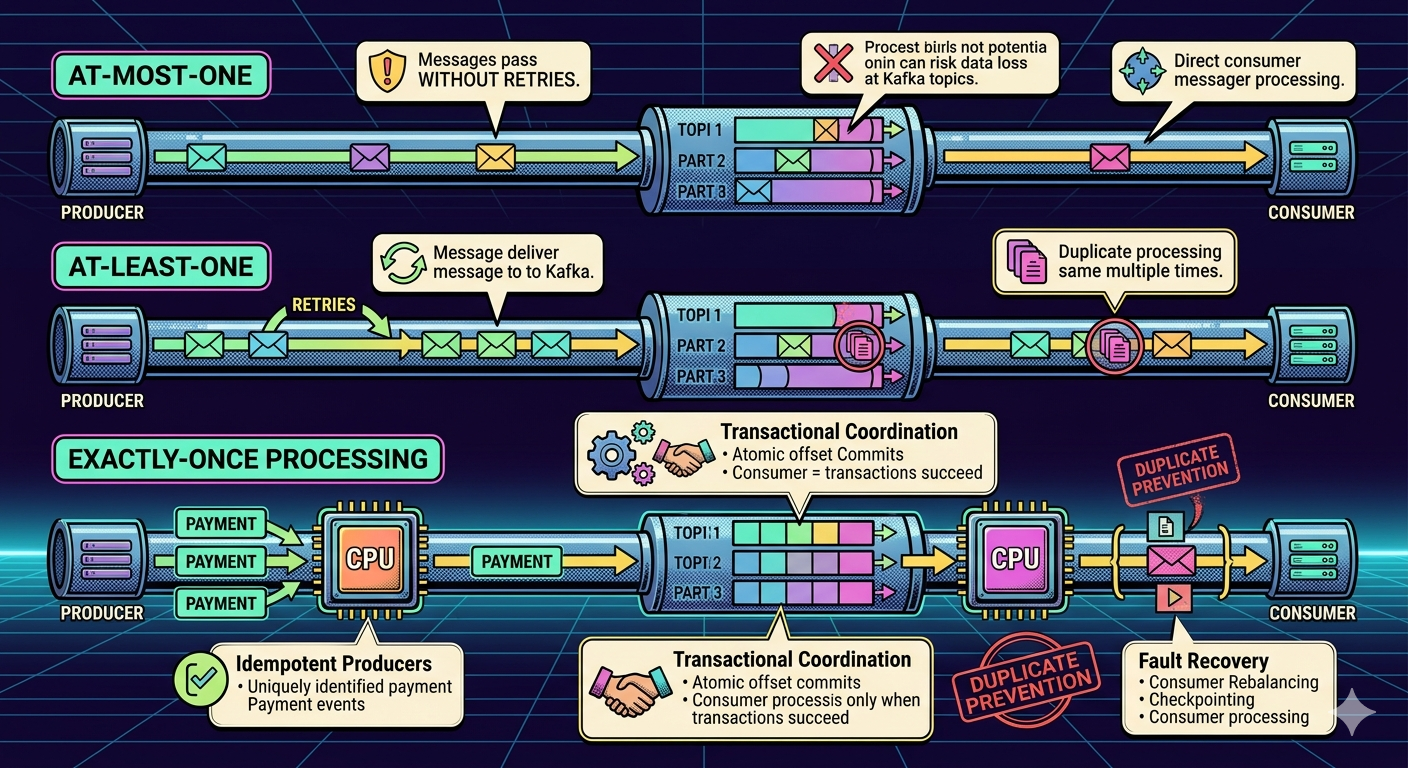
1. At-Most-Once Delivery
At-most-once means:
Messages may be lost, but never duplicated.
How It Works
Consumer commits offsets:
- before processing
Example:
Read Event
   ↓
Commit Offset
   ↓
Process Event
The Problem
Suppose:
Offset committed
Consumer crashes before processing
Result:
- Kafka thinks message was processed
- event is permanently skipped
Message lost.
Characteristics of At-Most-Once
Advantages:
- very fast
- low overhead
- no duplicates
Disadvantages:
- possible message loss
When It Is Acceptable
At-most-once may work for:
- metrics pipelines
- telemetry systems
- non-critical logs
- monitoring events
Not acceptable for:
- financial systems
- payments
- inventory updates
2. At-Least-Once Delivery
At-least-once means:
Messages are never lost, but duplicates may occur.
This is Kafka’s most common delivery model.
How It Works
Consumer:
- processes event first
- commits offset afterward
Example:
Read Event
   ↓
Process Event
   ↓
Commit Offset
The Problem
Suppose:
Event processed successfully
Consumer crashes before offset commit
After restart:
- Kafka re-delivers same event
Result:
- duplicate processing
Why Kafka Defaults Toward Duplicates
Kafka prefers:
Duplicate delivery over data loss.
Why?
Because:
- duplicates can often be handled
- lost financial transactions are unacceptable
This is an intentional design philosophy.
Characteristics of At-Least-Once
Advantages:
- no message loss
- strong reliability
Disadvantages:
- duplicates possible
Real-World Example
Suppose notification service processes:
PaymentCompleted
Before offset commit:
- consumer crashes
Kafka re-delivers event.
Customer receives:
- duplicate SMS
- duplicate email
This is common in distributed systems.
Why Duplicates Happen
Duplicates occur because:
- retries happen
- acknowledgments may fail
- offset commits are separate operations
- distributed coordination is imperfect
Exactly-once becomes difficult because:
Processing and acknowledgment are not inherently atomic.
3. Exactly-Once Semantics (EOS)
Exactly-once semantics attempts to guarantee:
Each event affects system state only once.
This is much harder than it sounds.
Important Clarification
Exactly-once does NOT mean:
- message physically delivered only once
Instead it means:
- system state changes occur exactly once
This distinction is critical.
Why Exactly-Once is Difficult
Consider this sequence:
Process payment
Update database
Send notification
Commit offset
What happens if crash occurs:
- after DB update
- before offset commit?
Kafka may re-deliver event.
Without safeguards:
- payment processes twice
Kafka’s Exactly-Once Solution
Kafka introduced:
- idempotent producers
- transactions
- atomic offset commits
Together these enable:
Exactly-once semantics within Kafka ecosystems.
Idempotency — The Core Concept
Before understanding EOS, we must understand:
Idempotency.
What is Idempotency?
An operation is idempotent if:
Executing it multiple times produces same final result.
Example:
Set account status = ACTIVE
Running repeatedly:
- does not create inconsistency
Non-Idempotent Example
Add ₹1000 to balance
Running twice:
- doubles money incorrectly
Non-idempotent operations are dangerous during retries.
Kafka Idempotent Producers
Kafka introduced:
Idempotent producers.
These producers prevent:
- duplicate writes caused by retries
Why Producer Retries Cause Duplicates
Suppose:
Producer sends event
Broker stores event
Acknowledgment lost
Producer retries
Without idempotency:
- duplicate messages appear
How Kafka Solves This
Kafka assigns:
- Producer IDs
- sequence numbers
Broker detects duplicates and ignores repeated writes.
This prevents duplicate records during producer retries.
Kafka Transactions
Idempotency alone is insufficient.
Kafka also introduced:
Transactions.
Transactions allow Kafka to:
- group multiple writes atomically
- coordinate offsets safely
Why Transactions Matter
Suppose consumer:
- reads event
- writes transformed result
- commits offset
Without transactions:
- partial completion possible
With transactions:
- all operations succeed together
- or all fail together
Transactional Workflow
Example:
Read payment event
   ↓
Generate fraud analysis
   ↓
Write result topic
   ↓
Commit offsets atomically
This creates consistent processing.
Read-Process-Write Pattern
Kafka EOS is especially powerful for:
Consume → Process → Produce
stream-processing pipelines.
This is heavily used in:
- Kafka Streams
- stream analytics
- fraud detection systems
Kafka Streams and Exactly-Once
Kafka Streams
has built-in EOS support.
Kafka Streams automatically coordinates:
- state updates
- writes
- offset commits
- transactions
This greatly simplifies reliable stream processing.
Important Limitation of Kafka EOS
One of the biggest misconceptions:
Kafka guarantees global exactly-once everywhere
Not true.
Kafka EOS works primarily:
- within Kafka-managed workflows
External systems complicate things.
External Database Problem
Suppose workflow:
Consume Kafka event
   ↓
Update MySQL database
   ↓
Commit Kafka offset
Crash timing can still create inconsistencies.
Kafka cannot fully control:
- external databases
- REST APIs
- third-party systems
Why Distributed Transactions Are Hard
True global exactly-once requires:
- distributed consensus
- cross-system atomicity
- coordinated commits
This becomes:
- slow
- complex
- operationally expensive
Most systems avoid full distributed transactions.
Eventual Reality — "Effectively Once"
In real-world systems, many engineers target:
Effectively-once processing.
Meaning:
- duplicates may technically occur
- system behavior remains correct
Usually achieved through:
- idempotency
- deduplication
- business safeguards
Real-World Payment Example
Suppose:
{
  "transactionId": "TXN5001"
}
Application checks:
- has transaction already been processed?
If yes:
- skip duplicate
This is practical idempotency.
Deduplication Strategies
Common approaches:
- unique transaction IDs
- database constraints
- idempotency keys
- event versioning
- state tracking
These are widely used in production systems.
Tradeoffs of Exactly-Once Semantics
EOS improves correctness but introduces:
- additional complexity
- transaction overhead
- latency increases
- operational considerations
Many systems intentionally choose:
- at-least-once + idempotency
instead.
Why Many Teams Prefer At-Least-Once
At-least-once with idempotent consumers often provides:
- simpler architecture
- excellent reliability
- operational flexibility
This is extremely common in production Kafka systems.
Real-World Delivery Strategy Examples
Payments
Usually:
- at-least-once
- strict idempotency
- transaction deduplication
Notifications
Often:
- at-least-once acceptable
Duplicate SMS is tolerable.
Lost payment is not.
Analytics Pipelines
Sometimes:
- occasional duplicates acceptable
Depends on aggregation design.
Monitoring Metrics
Often:
- at-most-once acceptable
Small inaccuracies tolerated.
Understanding the Truth About Exactly-Once
The phrase:
Exactly-once processing
is often misunderstood marketing shorthand.
In reality:
- distributed systems are probabilistic
- failures always exist
- guarantees involve tradeoffs
Kafka provides extremely strong tooling for correctness, but architecture design still matters enormously.
Common Beginner Misconceptions
Misconception 1
Exactly-once means no duplicate delivery
Duplicates may still occur internally.
Misconception 2
Kafka EOS automatically protects databases
External systems remain challenging.
Misconception 3
At-least-once is unreliable
At-least-once is often the safest practical strategy.
Misconception 4
Idempotency and EOS are the same thing
Idempotency is one component of reliable processing.
Why This Topic Matters So Much
Delivery guarantees affect:
- financial correctness
- operational reliability
- system consistency
- customer trust
- distributed architecture design
Understanding these tradeoffs is essential for real-world Kafka engineering.
Key Takeaways
Kafka supports three major delivery semantics:
| Delivery Model | Message Loss | Duplicates |
|---|---|---|
| At-most-once | Possible | No |
| At-least-once | No | Possible |
| Exactly-once | Prevented logically | Controlled carefully |
Kafka achieves exactly-once semantics using:
- idempotent producers
- transactions
- atomic offset coordination
However, true global exactly-once processing across distributed systems remains extremely difficult.
In practice, many real-world systems rely on:
- at-least-once delivery
- idempotent processing
- deduplication strategies
to achieve reliable and scalable event-driven architectures using:
Apache Kafka