How Kafka Powers Payment Processing Systems
Building Scalable, Real-Time Financial Event Pipelines with Kafka
Modern payment systems process enormous volumes of events continuously.
Every second, systems around the world handle:
- card payments
- UPI transactions
- bank transfers
- wallet payments
- refunds
- fraud checks
- settlement workflows
- customer notifications
Behind the scenes, these systems require:
- real-time responsiveness
- fault tolerance
- scalability
- durability
- auditability
- asynchronous processing
Traditional tightly coupled architectures struggle to handle this complexity at scale.
This is one of the major reasons organizations increasingly use:
Apache Kafka
to power payment infrastructures.
Kafka enables payment platforms to become:
- event-driven
- scalable
- resilient
- replayable
- real-time
In this article, we will deeply explore:
- how payment systems work
- why Kafka fits payment architectures
- payment event pipelines
- asynchronous workflows
- fraud integration
- retries and durability
- event-driven settlement
- real-world payment processing patterns
This article connects Kafka concepts directly to enterprise-grade financial systems.
Why Payment Systems Are Difficult
Payment systems are among the most demanding distributed systems in software engineering.
They must handle:
- extremely high throughput
- financial correctness
- low latency
- distributed coordination
- compliance requirements
- auditability
- failure recovery
And they must do all this:
In real time.
A Simple Payment Is Not Actually Simple
When customer clicks:
Pay Now
many systems become involved:
Payment Gateway
Fraud Detection
Ledger Service
Notification System
Inventory System
Analytics Platform
Settlement Engine
Audit System
This is a distributed workflow problem.
Traditional Synchronous Architecture Problem
Historically systems often used:
Payment Service
   ├── Call Fraud API
   ├── Call Notification API
   ├── Call Ledger API
   └── Call Analytics API
Problems:
- tight coupling
- cascading failures
- latency bottlenecks
- difficult scaling
If one service slows down:
- entire payment flow suffers.
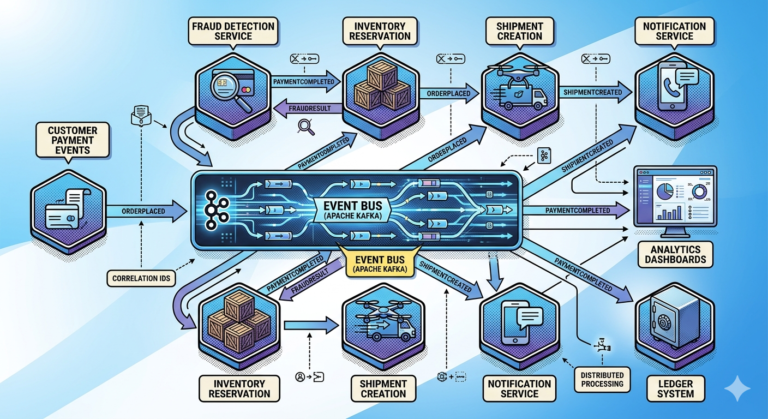
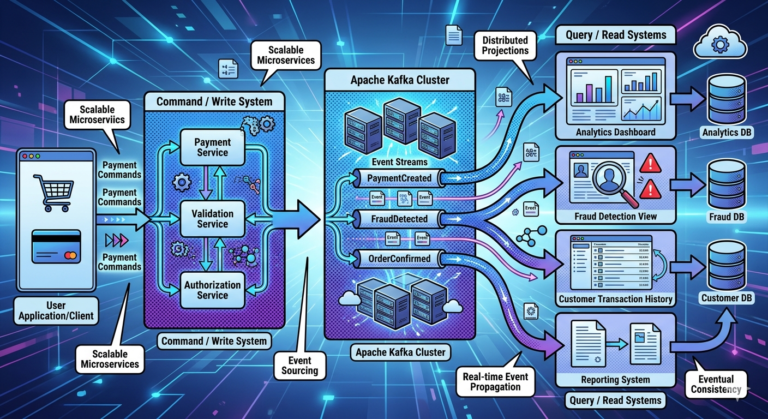
Event-Driven Payment Architecture
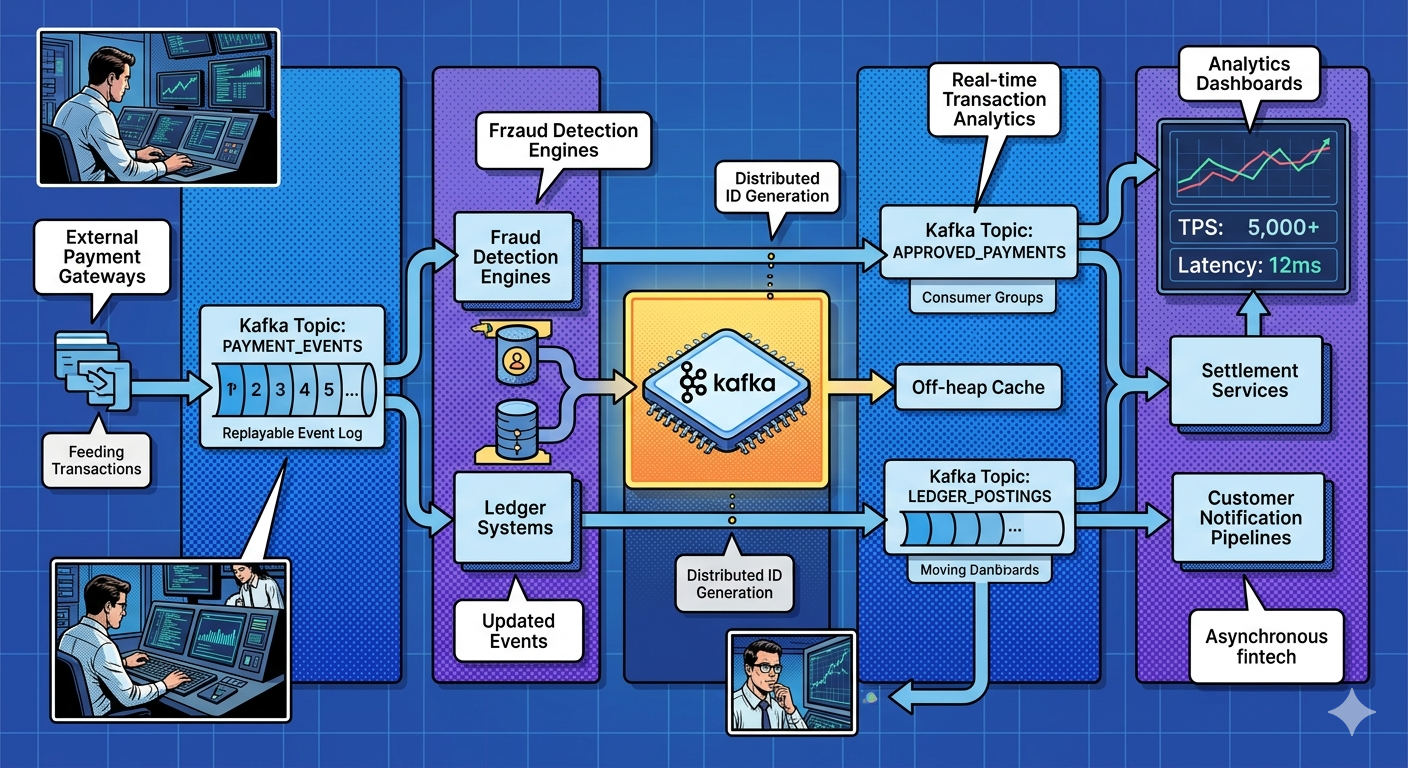
Kafka enables a much better approach:
Payment Service
      ↓
PaymentCompleted Event
      ↓
Kafka Topic
 ├── Fraud Detection
 ├── Ledger Service
 ├── Notifications
 ├── Analytics
 └── Settlement Engine
Now services react independently.
This creates:
- loose coupling
- asynchronous scaling
- fault isolation
Payment Systems Are Naturally Event-Driven
Payments naturally generate events.
Examples:
PaymentInitiated
PaymentAuthorized
PaymentCompleted
PaymentFailed
RefundIssued
ChargebackCreated
Kafka is designed precisely for:
Event-driven architectures.
Kafka as the Payment Backbone
Many modern payment platforms use:
Apache Kafka
as:
The central event backbone.
Kafka coordinates:
- event propagation
- workflow orchestration
- asynchronous processing
- real-time streaming
across distributed services.
Real-Time Payment Workflow
Let us walk through a realistic payment pipeline.
Step 1 — Payment Initiated
Customer submits payment.
Frontend service publishes:
{
  "eventType": "PaymentInitiated",
  "transactionId": "TXN9001",
  "customerId": "CUST100",
  "amount": 5000
}
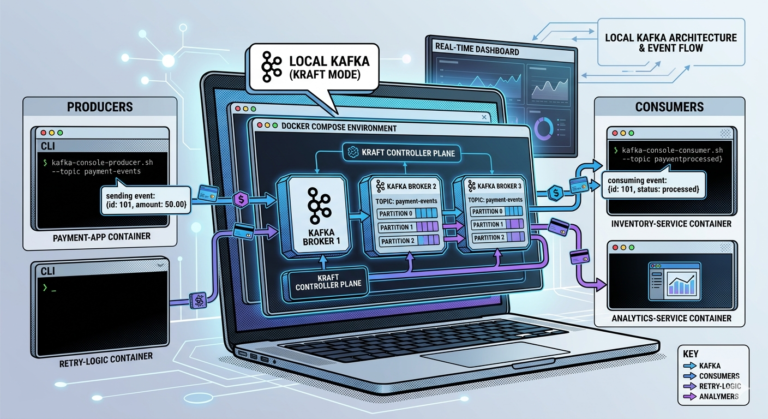
into Kafka topic:
payments
Step 2 — Payment Authorization
Payment processor consumes:
PaymentInitiated
Communicates with:
- banks
- card networks
- UPI systems
- payment gateways
If successful:
PaymentAuthorized
event published.
Step 3 — Fraud Detection
Fraud engine subscribes to:
payments topic
Consumes:
- transaction streams continuously
Analyzes:
- spending behavior
- geolocation anomalies
- transaction velocity
- device fingerprints
If suspicious:
FraudDetected
event generated.
Step 4 — Ledger Updates
Ledger service consumes:
PaymentCompleted
Updates:
- balances
- accounting records
- financial books
This service often requires:
- strong consistency
- ordering guarantees
- idempotency
Step 5 — Customer Notifications
Notification service independently consumes:
PaymentCompleted
Sends:
- SMS
- push notifications
Notice:
- payment service does not directly call notification service.
Kafka decouples them completely.
Step 6 — Analytics Pipelines
Analytics systems consume:
- payment streams
- fraud events
- settlement updates
Dashboards update:
- in real time.
Step 7 — Settlement Systems
Settlement engines process:
- merchant payouts
- reconciliation workflows
- clearing operations
using Kafka event streams.
Why Kafka Fits Payments So Well
Kafka provides several characteristics that payment systems desperately need.
1. Durability
Payments cannot disappear.
Kafka stores:
- durable append-only logs
Events survive:
- crashes
- restarts
- outages
2. Replayability
Suppose:
- downstream service fails
- accounting bug discovered
- analytics corrupted
Kafka allows:
- replaying historical transactions
This is extremely valuable.
3. Scalability
Payment systems may process:
- millions of transactions per hour
Kafka partitions distribute:
- workload horizontally
This enables massive scalability.
4. Fault Isolation
Suppose:
- notification service crashes
Payment processing continues normally.
Kafka retains events until recovery.
This improves resilience dramatically.
5. Real-Time Streaming
Kafka enables:
- sub-second event propagation
Critical for:
- fraud detection
- live analytics
- instant notifications
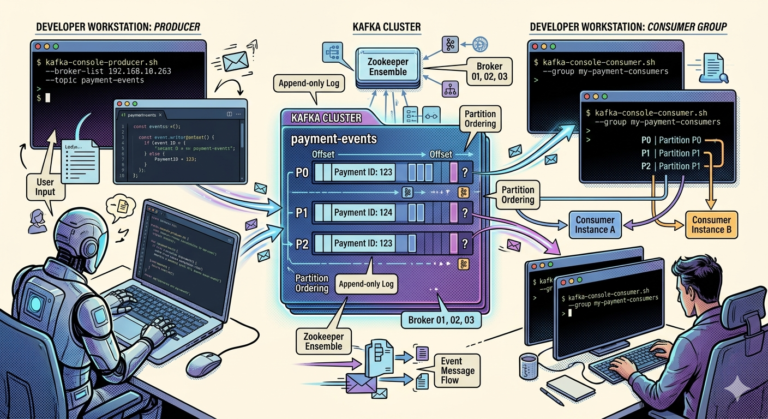
Partitioning in Payment Systems
Partitioning strategy is extremely important.
Many payment systems partition by:
Customer ID
Account ID
Merchant ID
This preserves:
- ordering consistency
for related financial events.
Why Ordering Matters in Payments
Suppose events occur:
Debit ₹500
Credit ₹1000
Refund ₹500
Incorrect ordering could:
- corrupt balances
- create inconsistent ledgers
Kafka guarantees:
- ordering within partitions
This is critical.
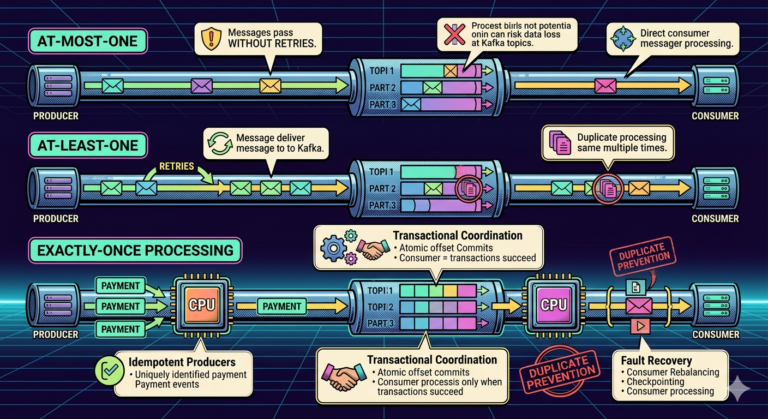
Exactly-Once Processing Concerns
Payments are highly sensitive to:
- duplicate processing
Example:
Duplicate charge
Duplicate refund
Duplicate settlement
Kafka systems often combine:
- at-least-once delivery
- idempotent consumers
- transactional processing
to maintain correctness.
Idempotency in Payment Systems
Suppose event processed twice:
{
  "transactionId": "TXN9001"
}
Consumer checks:
- already processed?
If yes:
- safely ignore duplicate
This is essential in financial systems.
Event Sourcing in Financial Systems
Many payment systems increasingly use:
Event sourcing.
Instead of storing only balances:
- systems store transaction events
Kafka topics become:
- immutable financial timelines
Auditability and Compliance
Financial systems require:
- audit trails
- transaction history
- forensic analysis
Kafka retention helps maintain:
- replayable event history
- immutable transaction streams
Critical for:
- compliance
- investigations
- reconciliation
Fraud Detection Pipelines
Fraud systems continuously consume:
- payment streams
- login activity
- behavioral events
Kafka enables:
- real-time fraud scoring
- anomaly detection
- stream analytics
This is one of Kafka’s strongest enterprise use cases.
Retry Handling in Payment Systems
Distributed systems fail regularly.
Examples:
- network interruptions
- gateway timeouts
- service crashes
Kafka retention allows:
- safe retries
- event replay
- recovery workflows
without losing transactions.
Dead Letter Queues (DLQ)
Suppose event processing repeatedly fails.
Kafka architectures often use:
Dead Letter Topics
Problematic payment events isolated safely for:
- investigation
- manual correction
Consumer Groups in Payment Pipelines
Different services consume independently:
payments topic
 ├── Fraud Group
 ├── Analytics Group
 ├── Notification Group
 ├── Settlement Group
 └── Audit Group
Kafka fan-out architecture scales naturally.
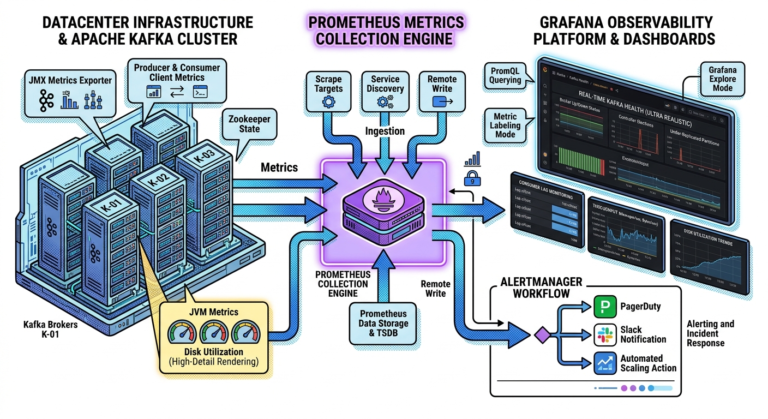
Real-Time Analytics for Payments
Kafka powers:
- transaction dashboards
- fraud monitoring
- payment success metrics
- operational health systems
using streaming analytics pipelines.
Global Scale Payment Systems
Large payment providers process:
- billions of transactions
- globally distributed streams
- massive concurrent workloads
Kafka’s distributed architecture makes this practical.
Why Traditional Architectures Struggle
Without Kafka:
- systems become tightly coupled
- retries become difficult
- scaling becomes painful
- recovery becomes complex
Kafka simplifies:
- distributed event coordination
at enterprise scale.
Real-World Payment Architecture Pattern
Many organizations implement:
Microservices
   ↓
Kafka Event Backbone
   ↓
Distributed Consumers
Kafka becomes:
- the asynchronous nervous system of payments infrastructure.
Common Beginner Misconceptions
Misconception 1
Kafka processes payments itself
Kafka transports and coordinates events.
Business logic remains inside applications.
Misconception 2
Kafka guarantees financial correctness automatically
Applications still require:
- idempotency
- validation
- transactional logic
Misconception 3
Payment systems require synchronous APIs everywhere
Most modern payment systems heavily use asynchronous workflows internally.
Misconception 4
Kafka is only for analytics
Kafka powers mission-critical transactional systems too.
Why Kafka Became So Important in Fintech
Modern fintech systems require:
- real-time processing
- distributed scalability
- fault tolerance
- event-driven coordination
- replayability
- streaming analytics
Apache Kafka
provides these capabilities extremely effectively.
This is why Kafka became foundational infrastructure for:
- payment gateways
- digital wallets
- banking systems
- financial platforms
- real-time transaction processing
Key Takeaways
Payment systems naturally generate:
- continuous streams of financial events
Kafka enables payment platforms to become:
- scalable
- resilient
- asynchronous
- event-driven
Kafka topics coordinate:
- fraud detection
- notifications
- ledger updates
- settlement workflows
- analytics pipelines
Kafka provides:
- durability
- replayability
- partitioned scalability
- fault isolation
- real-time event streaming
These capabilities make:
Apache Kafka
one of the most important technologies powering modern financial and payment infrastructures.