Core Components of Event-Driven Systems
Understanding Producers, Brokers, Consumers, and Event Streams
Event-Driven Architecture (EDA) is built around a simple but powerful idea:
Systems communicate by producing and consuming events.
But behind this idea lies a sophisticated ecosystem of components working together to enable:
- scalability
- asynchronous processing
- fault tolerance
- real-time responsiveness
- distributed communication
Technologies like:
Apache Kafka
provide the infrastructure that powers these event-driven systems at massive scale.
To design or work with modern Kafka-based architectures, it is essential to understand the core building blocks that make EDA possible.
In this article, we will explore:
- producers
- brokers
- consumers
- event streams
- topics
- event routing
- event storage
- messaging infrastructure
- how all components interact together
This article forms the bridge between conceptual EDA understanding and Kafka architecture fundamentals.
Why Understanding the Core Components Matters
Many beginners learn Kafka commands before understanding the architectural model underneath.
This creates confusion later when dealing with:
- partitions
- offsets
- scaling
- consumer groups
- delivery guarantees
- observability
Understanding the system components first makes the entire Kafka ecosystem much easier to understand.
The Big Picture of an Event-Driven System
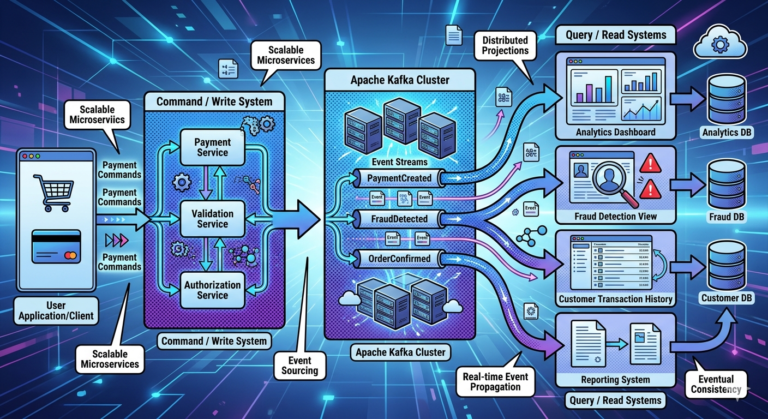
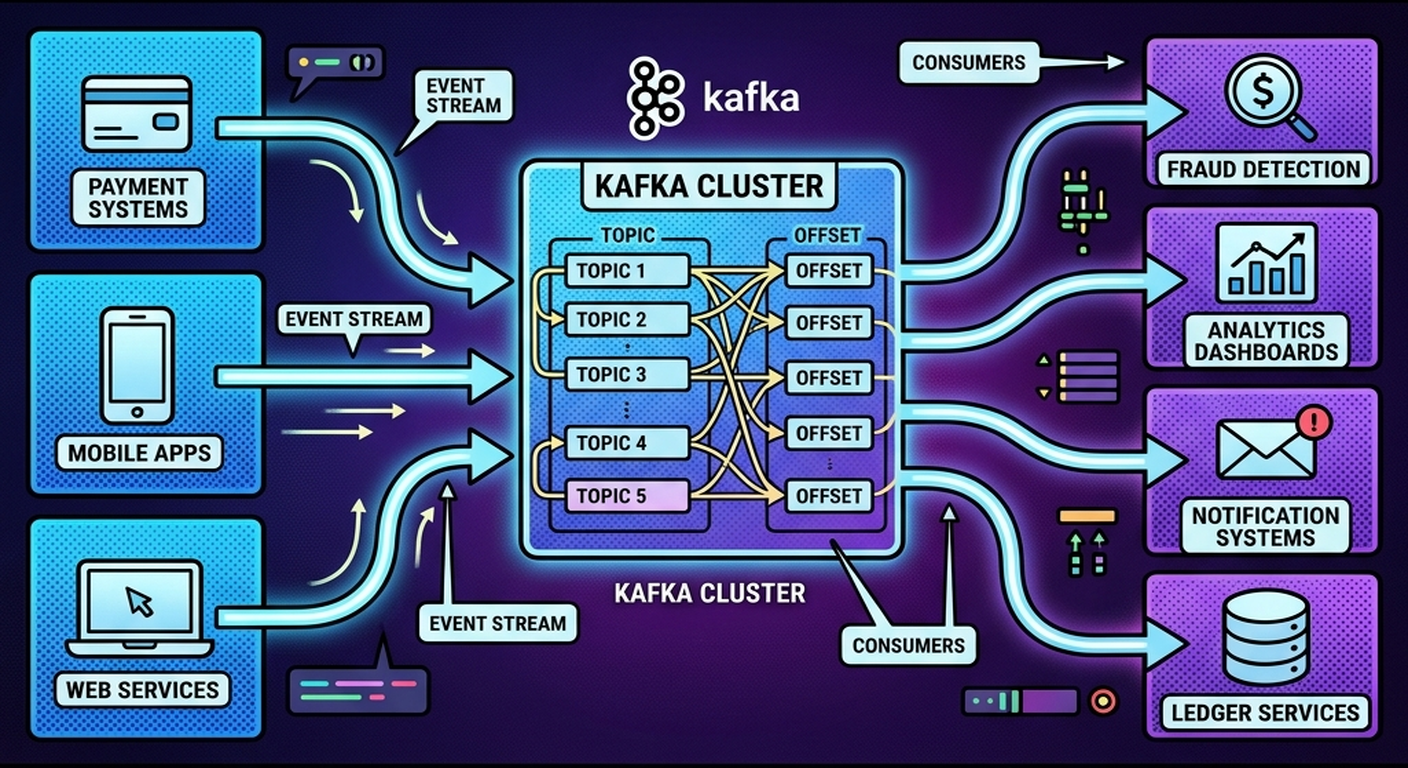
At a high level, an event-driven system looks like this:
Producer → Event Broker → Consumer
Simple on the surface.
But each component performs a critical role.
Real-World Example — Payment Processing System
Imagine an online payment platform.
When a customer makes a payment:
- the payment system processes the transaction
- fraud systems analyze behavior
- analytics systems update dashboards
- notifications are sent
- accounting ledgers update
Instead of directly calling every downstream service, the system publishes an event.
Example:
PaymentCompleted
This event flows through the event-driven system.
The Four Core Components
Most event-driven systems revolve around four major components:
- Producers
- Event Brokers
- Consumers
- Event Streams
Let us examine each one carefully.
1. Producers
A producer is a system that generates events.
Producers publish information whenever something important happens.
What Producers Do
A producer:
- creates events
- formats event data
- sends events to the broker
- optionally chooses routing keys or partitions
The producer does not care:
- who consumes the event
- how many consumers exist
- what consumers do afterward
This loose coupling is one of the biggest strengths of EDA.
Producer Examples
Examples of producers:
- payment applications
- e-commerce platforms
- mobile apps
- IoT devices
- banking systems
- web applications
Example Event from a Producer
{
  "eventType": "PaymentCompleted",
  "transactionId": "TXN5001",
  "customerId": "CUST100",
  "amount": 2500
}
The producer simply publishes the event.
Producers Enable Decoupling
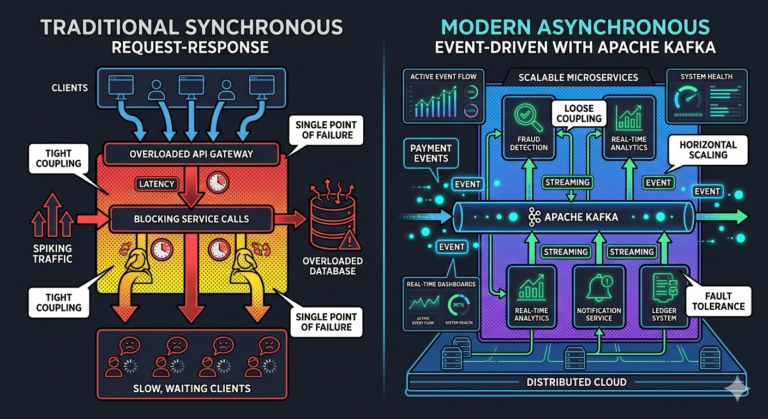
In traditional architectures:
Payment Service → Fraud Service
Payment Service → Notification Service
Payment Service → Analytics Service
The payment service directly depends on downstream systems.
In EDA:
Payment Service → Kafka Topic
That is all.
This dramatically simplifies the architecture.
2. Event Brokers
The event broker is the central backbone of the system.
This is where:
Apache Kafka
plays its role.
What is an Event Broker?
The broker:
- receives events from producers
- stores events durably
- distributes events to consumers
- manages scalability
- handles ordering
- supports fault tolerance
The broker acts like a highly scalable event distribution platform.
Popular Event Brokers
Common event brokers include:
- Apache Kafka
- RabbitMQ
- Apache Pulsar
- AWS Kinesis
- NATS
Kafka is especially popular because it combines:
- messaging
- event storage
- stream processing
- replay capability
in a single platform.
Why Brokers are Critical
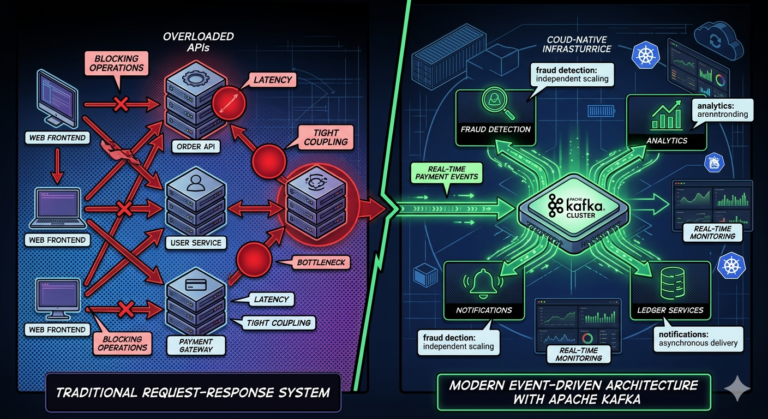
Without a broker:
Producer ↔ Consumer
Systems become tightly coupled.
With a broker:
Producer → Broker → Consumers
Systems become:
- independent
- scalable
- resilient
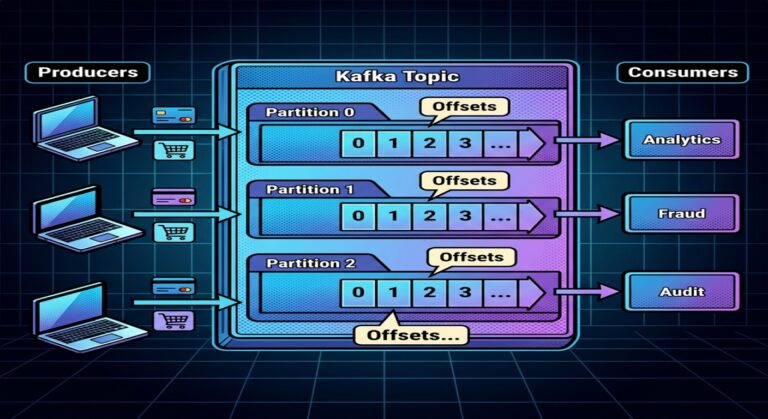
Kafka Topics
In Kafka, events are organized into:
Topics.
A topic is a logical stream of events.
Example topics:
payments
fraud-alerts
notifications
inventory-updates
Events related to the same domain are grouped together.
Topics as Event Channels
Think of topics like dedicated event channels.
Example:
payments topic
contains:
PaymentInitiated
PaymentCompleted
PaymentRefunded
Consumers subscribe to topics they are interested in.
Durable Event Storage
One major difference between Kafka and traditional messaging systems:
Kafka stores events durably.
Events remain available even after consumers process them.
This enables:
- replayability
- recovery
- auditing
- historical analytics
Event Retention
Kafka can retain events for:
- hours
- days
- weeks
- months
depending on configuration.
This transforms Kafka into both:
- a messaging system
- an event storage platform
3. Consumers
Consumers are systems that react to events.
They subscribe to topics and process incoming events independently.
Consumer Responsibilities
Consumers:
- read events
- process data
- trigger workflows
- update databases
- perform analytics
- generate new events
Consumer Examples
Examples:
- fraud detection services
- analytics pipelines
- notification systems
- accounting services
- recommendation engines
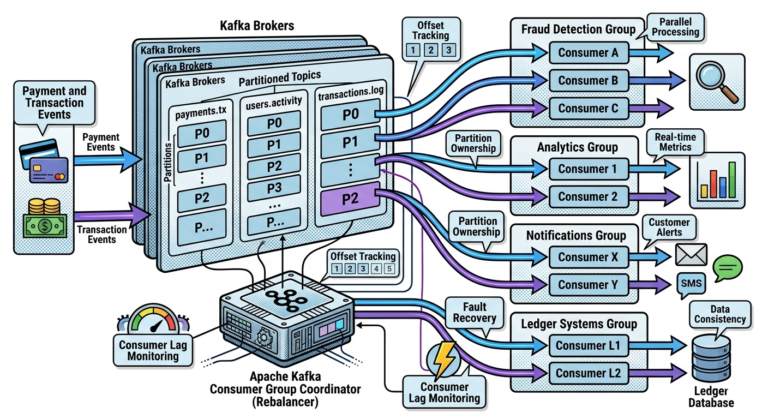
One Event, Multiple Consumers
One of the biggest strengths of EDA:
Multiple consumers can react to the same event simultaneously.
Example:
PaymentCompleted Event
     ├── Fraud Detection
     ├── Notification Service
     ├── Analytics Service
     └── Ledger Service
This enables highly extensible architectures.
Consumers Operate Independently
Consumers can:
- fail independently
- scale independently
- restart independently
without affecting producers.
This greatly improves system resilience.
4. Event Streams
An event stream is a continuous flow of events over time.
Example:
OrderPlaced
PaymentCompleted
InventoryReserved
ShipmentCreated
DeliveryCompleted
Streams represent chronological business activity.
Why Streams Matter
Streams enable:
- real-time processing
- live analytics
- continuous monitoring
- historical replay
- state reconstruction
Modern systems increasingly think in terms of streams rather than isolated database transactions.
Event Flow Lifecycle
Let us walk through a complete event lifecycle.
Step 1 — Business Action Occurs
A customer completes payment.
Step 2 — Producer Creates Event
{
  "eventType": "PaymentCompleted"
}
Step 3 — Producer Publishes Event
Event sent to Kafka topic:
payments
Step 4 — Broker Stores Event
Kafka:
- writes event to partition
- replicates data
- tracks offsets
Step 5 — Consumers Receive Event
Multiple services consume independently.
Step 6 — Systems React
Examples:
- fraud analysis
- SMS notification
- accounting update
- metrics aggregation
All asynchronously.
Loose Coupling — The Most Important Architectural Benefit
EDA systems are loosely coupled because:
- producers do not know consumers
- consumers do not know producers
- communication happens through events
This enables:
- independent deployments
- better scalability
- easier maintenance
- improved fault isolation
Comparing Traditional Systems vs Event-Driven Systems
Traditional Architecture
Frontend
   ↓
Payment API
   ├── Fraud API
   ├── Notification API
   └── Analytics API
Problems:
- direct dependencies
- cascading failures
- scaling challenges
Event-Driven Architecture
Frontend
   ↓
Payment Service
   ↓
Kafka
   ├── Fraud Consumer
   ├── Notification Consumer
   └── Analytics Consumer
Advantages:
- asynchronous workflows
- independent scaling
- resilience
- extensibility
Event Routing
The broker determines how events reach consumers.
Routing may depend on:
- topics
- partitions
- routing keys
- subscriptions
Kafka primarily routes events using:
- topics
- partitions
We will deeply explore partitions in upcoming articles.
Why Kafka Became So Popular
Apache Kafka became dominant because it provides:
- high throughput
- durable storage
- partitioned scalability
- fault tolerance
- distributed architecture
- consumer independence
- replay capability
It effectively acts as:
- event backbone
- streaming infrastructure
- distributed log
- messaging platform
for modern systems.
Event-Driven Systems Support Real-Time Architectures
Modern applications increasingly require:
- live dashboards
- streaming analytics
- fraud detection
- recommendation systems
- IoT processing
- observability pipelines
EDA enables all of these naturally.
Common Beginner Misconception
Many beginners think Kafka is “just a queue.”
It is much more than that.
Kafka combines:
- storage
- messaging
- streaming
- distributed coordination
- scalable event processing
into a unified architecture platform.
Key Takeaways
The four core components of EDA are:
| Component | Responsibility |
|---|---|
| Producer | Generates events |
| Broker | Stores and distributes events |
| Consumer | Processes events |
| Event Stream | Continuous flow of events |
Together, these components enable:
- loose coupling
- scalability
- resilience
- asynchronous communication
- real-time processing
Technologies like:
Apache Kafka
provide the infrastructure that powers these modern distributed systems.