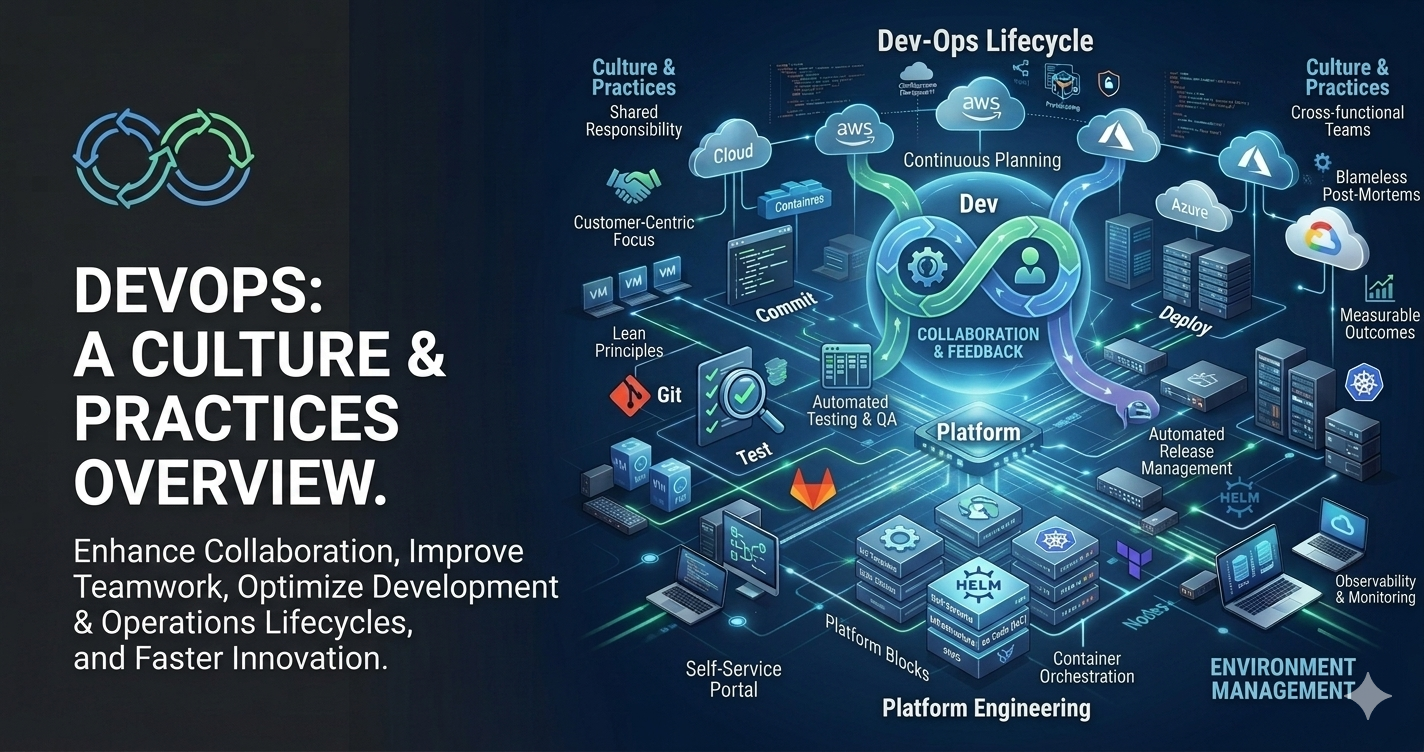
Introduction to DevOps: Bridging the Gap Between Development and Operations
Introduction to DevOps: Bridging the Gap Between Development and Operations
In the traditional world of software development, there was a distinct—and often contentious—wall between two groups: The Developers and The Operations team.
Developers were tasked with writing code and adding new features. Once the code was “finished,” they would “throw it over the wall” to the Operations team. Operations was then responsible for deploying that code, managing the servers, and ensuring the application stayed online.
The problem? Developers wanted change (new features), while Operations wanted stability (no crashes). This misalignment led to slow release cycles, finger-pointing during outages, and a frustrating experience for the end-user.
Enter DevOps.
What Exactly is DevOps?
Contrary to popular belief, DevOps is not a tool, a software package, or a specific job title. While there are “DevOps Engineers,” DevOps itself is a cultural philosophy and a set of practices designed to unify software development (Dev) and software operations (Ops).
At its core, DevOps is about breaking down silos to create a continuous loop of feedback, automation, and improvement. The goal is simple: to deliver high-quality software faster and more reliably.
The Three Pillars of DevOps
To understand how DevOps works, we can look at it through three primary lenses: Culture, Process, and Tools.
1. Culture: The Human Element
The most difficult part of DevOps isn’t the technology; it’s the mindset. A DevOps culture emphasizes:
- Shared Responsibility: Developers don’t just write code; they care about how it runs in production. Operations teams are involved early in the design phase.
- Psychological Safety: Instead of blaming individuals when a server crashes (the “blame game”), teams conduct “blameless post-mortems” to identify systemic failures and fix them.
- Collaboration: Constant communication ensures that everyone is aligned on the goal: delivering value to the customer.
2. Process: The Infinite Loop
You have likely seen the infinity symbol $\infty$ associated with DevOps. This represents the Continuous Lifecycle. Unlike the old “Waterfall” model where steps happened linearly, DevOps is a continuous loop:
- Plan: Defining requirements and designing the sprint.
- Code: Writing the software and performing peer reviews.
- Build: Compiling the code and creating artifacts (e.g., Docker images).
- Test: Automated testing to ensure no regressions were introduced.
- Release: Deploying the code to a staging or production environment.
- Deploy: Making the features available to users.
- Operate: Managing the infrastructure and scaling.
- Monitor: Gathering data on performance and user behavior, which feeds back into the Plan phase.
3. Tools: The Enablers
Tools don’t make you DevOps, but they enable the processes. Without automation, the “infinite loop” would be too slow to be effective.
The Heart of DevOps: CI/CD
If DevOps is the philosophy, CI/CD is the engine that drives it. CI/CD stands for Continuous Integration and Continuous Deployment (or Delivery).
Continuous Integration (CI)
CI is the practice of merging all developer working copies to a shared mainline several times a day.
- The Process: Every time a developer pushes code to a repository (like GitHub), an automated system triggers a build and runs a suite of tests.
- The Benefit: Bugs are caught instantly. You no longer have “merge hell” at the end of a month-long development cycle.
Continuous Delivery & Deployment (CD)
While often used interchangeably, there is a subtle difference:
- Continuous Delivery: The code is always in a “deployable state.” However, a human still pushes a button to trigger the final release to production.
- Continuous Deployment: Every change that passes all stages of your production pipeline is released to your customers automatically. No human intervention is required.
The DevOps Toolchain: A Quick Reference
To implement these processes, engineers use a variety of tools. Here is a breakdown of the most common categories:
| Stage | Popular Tools | Purpose |
|---|---|---|
| Source Control | Git, GitHub, GitLab | Versioning code and collaborating. |
| CI/CD Pipelines | Jenkins, GitHub Actions, CircleCI | Automating the build, test, and deploy flow. |
| Containerization | Docker, Podman | Packaging apps so they run the same everywhere. |
| Orchestration | Kubernetes (K8s) | Managing thousands of containers at scale. |
| IaC (Infrastructure as Code) | Terraform, Ansible, Pulumi | Managing servers using code instead of manual clicks. |
| Monitoring/Logging | Prometheus, Grafana, ELK Stack | Tracking health and debugging in real-time. |
Key Concepts You Need to Know
As you dive deeper into DevOps, you will encounter these three critical concepts:
Infrastructure as Code (IaC)
Imagine needing to spin up 50 servers. Doing this manually in a cloud console is slow and error-prone. IaC allows you to write a script (e.g., a Terraform file) that describes your infrastructure. You can version-control this file, meaning your infrastructure is now as reproducible and searchable as your application code.
Microservices
Instead of one giant “Monolith” application, DevOps often leverages Microservices. This architecture breaks an app into small, independent services (e.g., a “Payment Service” and a “User Service”). This allows teams to deploy a change to the Payment Service without risking the entire application.
Observability
Monitoring tells you that something is broken (e.g., “CPU is at 99%”). Observability allows you to understand why it is broken by looking at traces, logs, and metrics.
Summary: How to Get Started
If you are a developer or a sysadmin looking to move toward a DevOps approach, start small:
- Automate one thing: Start with a simple GitHub Action that runs your tests on every push.
- Containerize your app: Try putting your app in a Docker container to eliminate the “it works on my machine” excuse.
- Focus on feedback: Set up a basic dashboard to see how your app is performing in production.
DevOps is a journey, not a destination. It is about the constant pursuit of removing friction and delivering value to the user as efficiently as possible.