Artificial IntelligenceMachine LearningDeep LearningAI EcosystemAI DeploymentAI Frameworks
Introduction to the Modern AI Ecosystem
July 13, 2026• Vinod Kumar Kayartaya
Introduction to the Modern AI Ecosystem
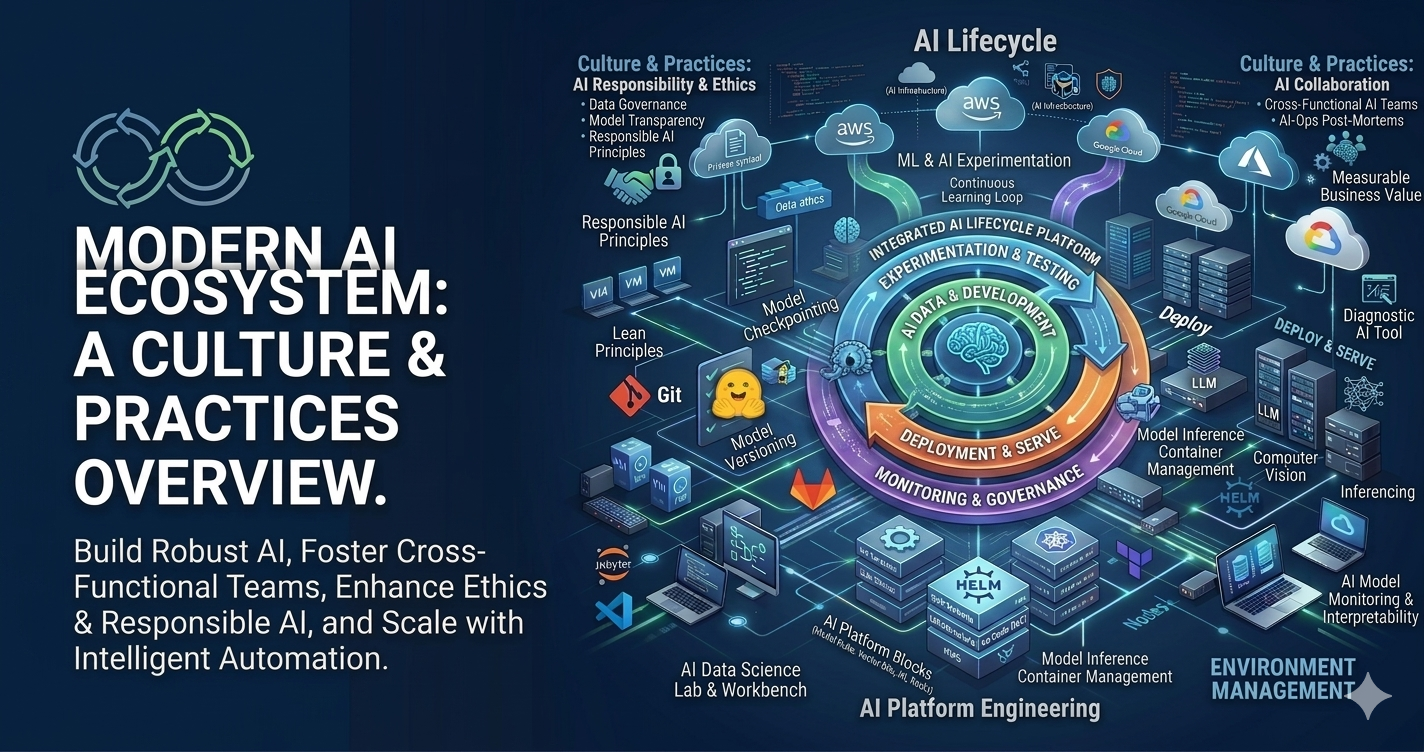
Artificial Intelligence (AI) is no longer a niche research topic. It permeates business tools, consumer products, and scientific discoveries. Yet newcomers often feel overwhelmed by the sheer number of libraries, services, and best‑practice patterns. This post takes you on a journey through the modern AI ecosystem – from foundational concepts to production‑ready pipelines – so you can understand what pieces fit together and how to start building intelligent applications.
TL;DR:
The AI ecosystem is a stack consisting of data → model training → model serving → observability → business value.
Key players: Python (NumPy, Pandas), Scikit‑learn, PyTorch, TensorFlow, Jupyter, Azure/MLOps, Vertex AI, ONNX, Docker/Kubernetes, CI/CD, and monitoring tools.
1. The Layers of an AI Pipeline
| Layer |
What It Does |
Typical Tools |
| Data Ingestion & Exploration |
Pulling, cleaning, and exploring raw data |
Pandas, Dask, Spark, Azure Data Factory, Google Cloud Dataflow |
| Feature Engineering |
Transforming raw signals into model‑ready representations |
scikit-learn, Featuretools, TensorFlow Feature Columns |
| Model Development |
Training supervised/unsupervised models |
PyTorch, TensorFlow/Keras, XGBoost, LightGBM, CatBoost |
| Model Versioning & Experiment Tracking |
Keeping reproducible records |
MLflow, Weights & Biases, DVC, Neptune.ai |
| Model Packaging & Conversion |
Preparing a model for serving |
ONNX, TorchScript, TensorFlow SavedModel |
| Model Deployment & Serving |
Exposing inference as a service |
FastAPI, TensorFlow Serving, TorchServe, Kubeflow Serving, Vertex AI, SageMaker |
| Pipeline Orchestration |
Scheduling training jobs, retraining, back‑fill |
Airflow, Prefect, Dagster, Azure Pipelines |
| Infrastructure Management |
Provisioning compute, storage, networking |
Kubernetes, Helm, Terraform, Pulumi, Managed services |
| Observability & Monitoring |
Tracking inference latency, drift, failure rates |
Prometheus, Grafana, TorchServe metrics, Seldon Core, Vertex AI Monitoring |
| Governance & Compliance |
Data privacy, model interpretability |
SHAP, LIME, IBM AI Explainability 360, OpenAI policy frameworks |
2. Data: The Foundation
2.1 Quality over Quantity
- Clean, balanced, and representative data is king. Garbage In = Garbage Out.
- Data leakage: avoid using target‑related features during training that won’t exist at inference.
- Bias & fairness: use metrics like disparate impact, demographic parity, and model‑agnostic explainers.
2.2 Common Data Sources
| Source |
Typical Use‑Case |
Connector |
| Databases (SQL/NoSQL) |
E‑commerce user logs, CRM data |
SQLAlchemy, MongoDB driver |
| Streaming (Kafka, Pulsar) |
Real‑time fraud detection |
Confluent Kafka client |
| Cloud Storage (S3, GCS, Azure Blob) |
Image/Video corpora |
Boto3, Google Cloud Storage API |
| Public Datasets |
Benchmarking |
Kaggle, UCI, OpenML |
2.3 Exploratory Data Analysis (EDA) in Jupyter
import pandas as pd
import seaborn as sns
import matplotlib.pyplot as plt

df = pd.read_csv("sales.csv")
sns.histplot(df["price"], bins=50)
plt.title("Price Distribution")
plt.show()
3. Feature Engineering & Representation Learning
3.1 Hand‑crafted Features
| Technique |
Example |
| One‑hot encoding |
pd.get_dummies() |
| Interaction terms |
X['feat1*feat2'] = X['feat1'] * X['feat2'] |
| Aggregations |
Group‑by mean/median per customer |
3.2 Automatic Feature Discovery
- Featuretools: Automated feature synthesis.
- TensorFlow Feature Columns: Declarative feature definition for dense‑vector embedding.
- AutoML: Google AutoML Vision, Vertex AI AutoML Tables.
3.3 Representation Learning
- Embeddings: Word2Vec, GloVe, Sentence Transformers, Node2Vec.
- Autoencoders: Dimensionality reduction (e.g., visual compression).
4. Model Development & Experimentation
4.1 Choosing the Right Framework
| Problem |
Suggested Framework |
Notes |
| NLP |
PyTorch + HuggingFace Transformers |
State‑of‑the‑art |
| CV |
TensorFlow + Keras |
Efficient training on TPUs |
| Tabular |
XGBoost / LightGBM |
Faster inference; less resource |
| Reinforcement Learning |
Stable Baselines3 |
Built on PyTorch |
4.2 Scaling Training
- Mixed‑precision (
torch.cuda.amp) to reduce memory.
- Data parallelism (
DistributedDataParallel).
- Model parallelism (partition across GPUs).
- Google Cloud TPU or AWS Inferentia for inference.
4.3 Experiment Tracking
import mlflow
import mlflow.sklearn

mlflow.start_run()
mlflow.log_param("learning_rate", 0.01)
mlflow.log_metric("accuracy", 0.91)
mlflow.sklearn.log_model(sklearn_model, "model")
mlflow.end_run()
5. Packaging & Model Conversion
| Workflow |
From |
To |
Use‑Case |
| PyTorch to TorchScript |
.pt |
.ts |
Deploy on embedded device |
| Keras to SavedModel |
.h5 |
SavedModel |
Deploy on TensorFlow Serving |
| Any framework to ONNX |
.pt/.h5 |
.onnx |
Interoperability |
python -m torch.jit.trace --input @input.npy export.pt
6. Model Serving
6.1 REST APIs with FastAPI
from fastapi import FastAPI
import torch, json

app = FastAPI()
model = torch.jit.load("export.pt")

@app.post("/predict")
async def predict(payload: dict):
    data = torch.tensor(payload["input"])
    out = model(data).detach().numpy().tolist()
    return {"prediction": out}
Deploy this to Kubernetes with Helm or Docker‑Compose for local dev.
- Vertex AI Predict (Google Cloud)
- AWS SageMaker Endpoints
- Azure ML Online Endpoint
- KServe / Seldon Core on any Kubernetes cluster
7. Orchestration & CI/CD
| Tool |
Strength |
| Airflow |
Proven schedulers, DAGs as Python |
| Prefect |
Modern API, flows, backpressure |
| Dagster |
Strong type checking, dev‑ops integration |
| Kubeflow Pipelines |
Runs on Kubernetes, model registry integration |
Example Airflow DAG snippet:
from airflow import DAG
from airflow.operators.bash import BashOperator
from datetime import datetime

with DAG('train_and_deploy', start_date=datetime(2023, 1, 1), schedule_interval='@daily') as dag:
    train = BashOperator(task_id='train', bash_command='python train.py')
    package = BashOperator(task_id='package', bash_command='bash pack.sh')
    deploy = BashOperator(task_id='deploy', bash_command='kubectl rollout restart deployment/model-serving')
    train >> package >> deploy
8. Observability & Model Monitoring
Key metrics:
- Latency & throughput –
prometheus + Grafana
- Prediction drift – compare feature distributions over time
- Accuracy decay – periodic re‑evaluation on hold‑out
- Explainability – SHAP, LIME visualizations
Open‑source stack: seldon-core + prometheus + K8s events.
9. Governance, Bias, and Ethical Considerations
| Aspect |
Checklist |
| Data Privacy |
GDPR, CCPA compliance, differential privacy |
| Fairness |
Auditing tools (AI Fairness 360) |
| Explainability |
Model cards (Google), Uber’s “Model Card Toolkit” |
| Lifecycle Management |
Versioning, rollback, deprecation notifications |
| Security |
Hardened inference endpoints, JWT authentication |
10. Case Study: End‑to‑End Loan Approval System
- Data – Retrieve historical applicant data from Postgres.
- Feature Engineering – Encode categorical fields, compute credit scores.
- Model – Gradient Boosted Trees (XGBoost) optimized with Optuna.
- Tracking – MLflow to log hyper‑parameters/metrics.
- Packaging – Export to ONNX.
- Serving – Deploy FastAPI endpoint on Kubernetes, autoscale with KEDA.
- Monitoring – Prometheus for latency, Grafana dashboards for drift.
- Governance – Model card, bias metrics, GDPR data handling.
11. Resources & Further Reading
12. Take‑Away Checklist
With this map, you can navigate the modern AI ecosystem confidently and start building production‑ready AI solutions. Happy modeling!