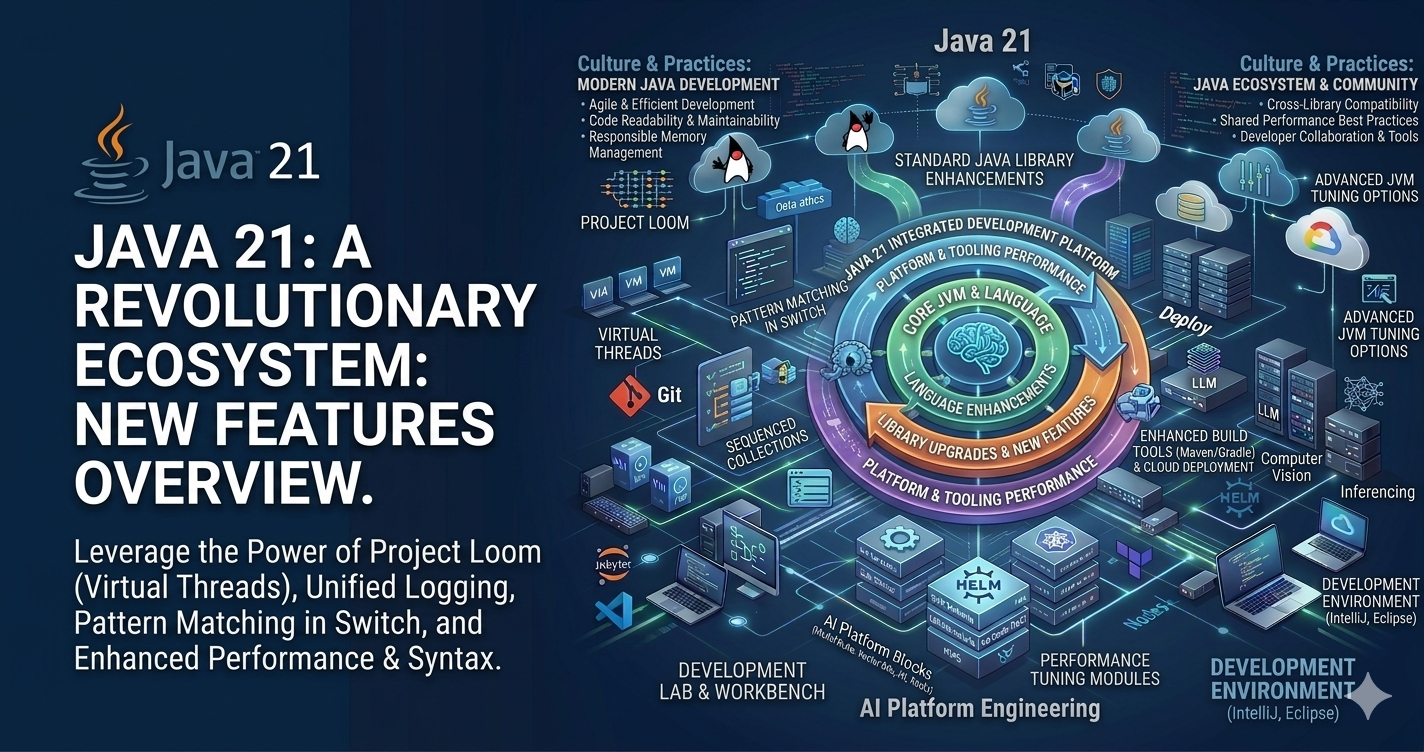
What's New in Java 21: A Comprehensive Overview
What’s New in Java 21: A Comprehensive Overview
Java 21 (released in September 2023) is the latest Long‑Term Support (LTS) version of the platform. It builds on the momentum of recent releases by introducing a handful of language‑level features, significant API enhancements, and major Project Loom improvements that make concurrent programming easier and more efficient. This article walks you through the most impactful changes, shows how they work with short code snippets, and points out what you should consider when migrating an existing codebase.
1. Language‑Level Enhancements
1.1 Record Patterns (Preview → Stable)
What’s new: Java 21 upgrades record patterns from a preview feature to a stable language construct. You can now de‑construct records directly in pattern‑matching contexts (instanceof, switch).
record Point(int x, int y) {}

public boolean isNegative(Point p) {
    return p instanceof Point(int x, int y)
            && x < 0 && y < 0;
}
Why it matters: Record patterns eliminate boilerplate code when you need to inspect multiple record components, making your code more readable and concise.
1.2 Pattern‑Matching for Switch (Second Stage)
What’s new: The “enhanced” switch expression now supports pattern‑matching for both instanceof and record patterns, completing the feature introduced in Java 17.
Object obj = new Point(2, 3);
String result = switch (obj) {
    case Point(int x, int y) when x > y -> "x is larger";
    case Point(int x, int y)               -> "x and y are equal or y larger";
    default                                 -> "unknown";
};
Why it matters: You can now combine pattern matching, guards, and switches in a single, expressive construct, reducing the need for nested if/else chains.
2. Concurrency & Performance Improvements
2.1 Virtual Threads (Project Loom)
What’s new: Virtual threads are now generally available (no longer a preview). They provide a lightweight alternative to platform threads for I/O‑bound workloads, dramatically reducing thread‑creation overhead.
try (var executor = Thread.ofVirtual().name("virt-", 0).unstartedPool()) {
    executor.execute(() -> {
        // Typical web‑service call or file read
        try {
            HttpClient client = HttpClient.newHttpClient();
            HttpRequest request = HttpRequest.newBuilder()
                .uri(URI.create("https://example.com"))
                .build();
            client.send(request, HttpResponse.BodyHandlers.ofString());
        } catch (IOException | InterruptedException e) {
            Thread.currentThread().interrupt();
        }
    });
}
Why it matters: You can now write ExecutorService-based code using Thread.ofVirtual() and treat each task as if it were a cheap thread, without manually tuning thread pools.
2.2 Structured Concurrency
What’s new: A new API (StructuredConcurrency and related interfaces) lets you compose multiple asynchronous tasks as a single logical unit, simplifying error handling and resource management.
// Using the new Structured Concurrency helpers (simplified)
try (var scope = new StructuredTaskScope.ShutdownOnFailure()) {
    // Fork two async tasks
    var priceTask = scope.fork(() -> fetchPriceAsync("AAPL"));
    var newsTask = scope.fork(() -> fetchNewsAsync("tech"));

    // Wait for both – if any fails, the whole scope fails fast
    scope.join();                       // throws Exception if any child failed
    String price = priceTask.result();  // OK
    String news = newsTask.result();    // OK
    // Use price + news …
}
Why it matters: Historical Future‑based code required manual try‑catch blocks and bookkeeping. Structured concurrency bundles the tasks, automatically propagates failures, and guarantees proper cleanup.
3. Core API Expansions
3.1 New Methods in java.lang.Record
Java 21 adds a handful of convenience methods to Record classes:
canonicalConstructor()– returns aConstructor<Record>for the canonical constructor.copy()– creates a copy with a given component value.
record Employee(String name, double salary) {}

Employee e = new Employee("Alice", 75_000);
// Retrieve the canonical constructor
Constructor<Employee> ctor = Employee.class.canonicalConstructor();

// Create a copy with updated salary
Employee e2 = e.copy(salary -> salary * 1.10);
3.2 Sequenced Collections (List and Map)
What’s new: List and Map now expose sequenced views (List.of(…), Map.ofEntries(…)) that preserve insertion order and support reversed(), iterator(), and descendingIterator() without extra steps.
List<Integer> squares = List.of(1, 2, 3).stream()
                             .map(i -> i * i)
                             .toList();

List<Integer> reversed = squares.reversed(); // [9,4,1]
3.3 Enhanced String Utilities (indent, stripIndent)
The String class now ships with indent(int n) and stripIndent() methods, making formatting multi‑line text straightforward.
String text = """
    This is a
    multi‑line string
    with extra spaces.
    """;

String indented = text.indent(2);   // adds two spaces to each line
String clean   = text.stripIndent();// removes uniform leading whitespace
3.4 New java.time Extensions
YearMonthnow hasatEndOfMonth()for easy temporal calculations.LocalDateTimecan be parsed withChronoFieldsupport for strict validation.
4. Tooling & Developer Experience
| Feature | Java 21 Impact |
|---|---|
| Javadoc | Inline documentation now renders record patterns and switch patterns directly in the generated API docs. |
| IDE Support | Eclipse, IntelliJ, and VS Code provide full code‑completion and refactoring for virtual threads and pattern‑matching constructs. |
| JDK Mission Control & Flight Recorder | New sampling modes capture virtual‑thread lifecycle events, giving you deeper insight into low‑overhead I/O workloads. |
| Packaging (Java 21) | jlink now includes support for native images, reducing the footprint of custom runtimes for containers. |
5. Migration Checklist
| Area | Action Items |
|---|---|
| Codebase Compatibility | Run javac --release 21 or newer to ensure source‑level compatibility. Most code works unchanged, but watch for uses of deprecated strictfp or obsolete APIs. |
| Concurrency | If you currently manage large thread pools for I/O work, consider migrating to Thread.ofVirtual() for better scalability. |
| Pattern Matching | Replace verbose instanceof + cast blocks with the new pattern‑matching syntax. The change is purely syntactic; compile‑time behavior remains identical. |
| Records | No migration needed for existing records, but you can now use record patterns and the new record utilities. |
| Testing | Run your existing test suite under the new LTS to catch any behavioral differences introduced by StructuredConcurrency or virtual threads. |
6. Looking Ahead
Java 21 paves the way for future releases:
- Project Loom continues to mature, and later JDKs (e.g., Java 22 preview) will bring structured concurrency refinements and string templates.
- Language level – the Roadmap hints at further ergonomics around pattern matching and sealed interfaces.
- Performance – continued work on foreign‑function & memory APIs (Project Panama) aims to shrink the gap between Java and natively‑written code.
Even if you are already comfortable with Java 17 or Java 20, adopting Java 21 now gives you access to production‑ready virtual threads, clearer concurrency semantics, and expressive pattern‑matching constructs—all of which can simplify code, boost performance, and improve developer happiness.
7. Quick Reference – Cheat Sheet
// Record pattern + switch
Object obj = new Point(5, 5);
String s = switch (obj) {
    case Point(int x, int y) -> x == y ? "equal" : "different";
    default -> "unknown";
};

// Virtual thread (simplified)
Thread.startVirtualThread(() -> {
    // I/O bound work
    HttpClient.newHttpClient()
              .sendAsync(...)
              .thenAccept(...);
});

// Structured concurrency
try (var scope = new StructuredTaskScope.ShutdownOnFailure()) {
    var f1 = scope.fork(() -> fetchFromA());
    var f2 = scope.fork(() -> fetchFromB());
    scope.join(); // rethrow first failure
    var resultA = f1.result();
    var resultB = f2.result();
}
Conclusion – Java 21 brings a balanced mix of language ergonomics, concurrency breakthroughs, and API polish that make modern Java development more expressive and performant. Whether you’re building micro‑services that rely on virtual threads, refactoring monolithic conditionals with pattern‑matching switches, or simply wanting a more stable, long‑supported platform, Java 21 is a compelling upgrade worth exploring today.
Happy coding, and enjoy the richer, more concurrent Java experience!