EDA vs Request-Response Architecture — Which One Should You Use?
Modern software systems are expected to handle:
- millions of users
- real-time interactions
- distributed services
- instant notifications
- high scalability
- fault tolerance
As systems evolve, architects often face a critical decision:
Should the system use traditional request-response communication or adopt an Event-Driven Architecture (EDA)?
Both architectural styles are widely used, and both solve different categories of problems effectively. The key is understanding where each approach fits best.
In this article, we will deeply compare:
- request-response systems
- event-driven systems
- synchronous vs asynchronous communication
- scalability characteristics
- failure handling
- operational complexity
- real-world use cases
By the end, you will understand:
- when request-response is sufficient
- when EDA becomes necessary
- why modern enterprises often combine both approaches
Understanding Request-Response Architecture
Request-response is the most familiar communication model in software systems.
A client sends a request.
The server processes it and returns a response.
Simple.
Basic Workflow
Client → Server → Response
Example:
POST /makePayment
The client waits until:
- processing completes
- data is stored
- validations finish
- response is returned
This is called synchronous communication.
Characteristics of Request-Response Systems
1. Synchronous Communication
The client waits for completion.
Request Sent → Waiting → Response Received
2. Tight Service Dependency
If Service A depends on Service B:
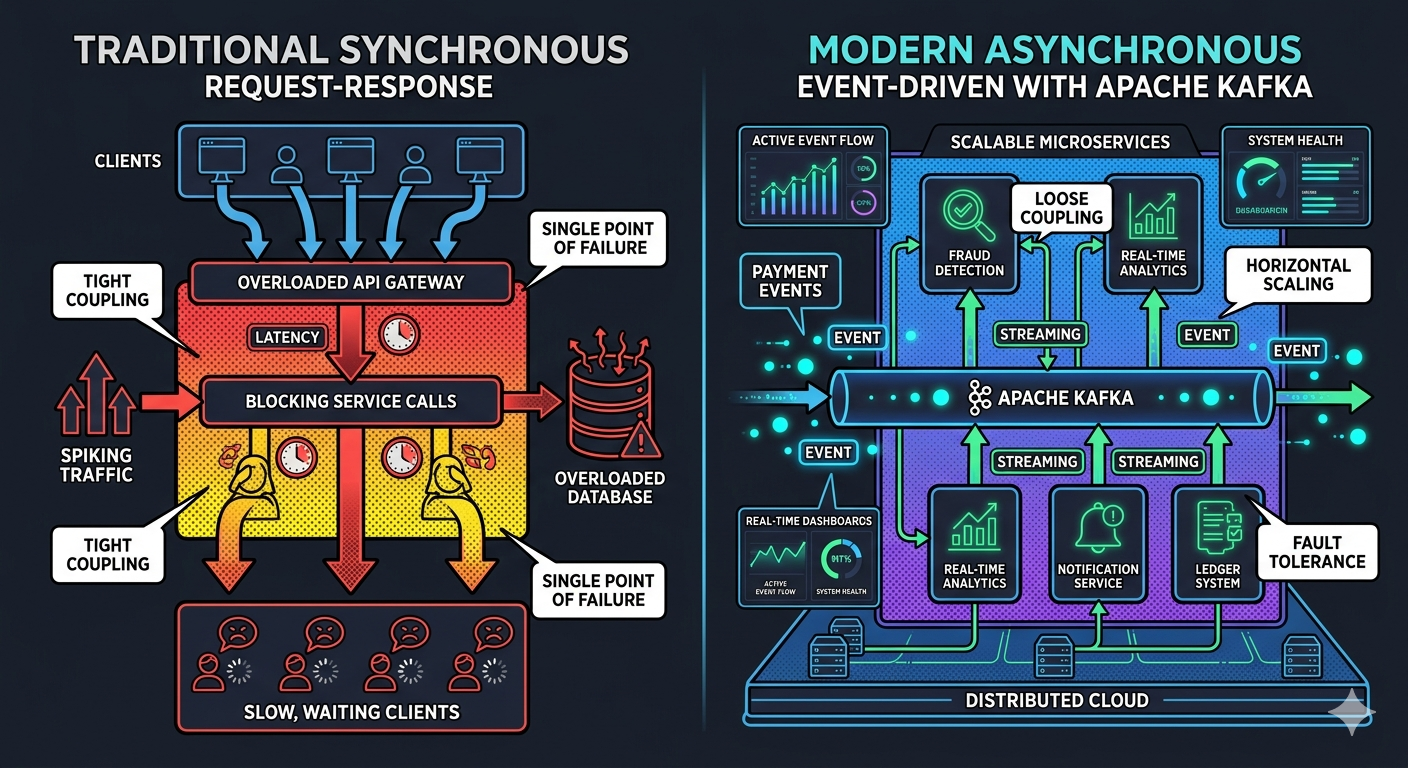
Frontend → Payment API → Fraud API → Notification API
Every service directly depends on another service being available.
3. Immediate Response
The client gets an instant success or failure response.
This works well for:
- login systems
- form submissions
- CRUD applications
- dashboards
- transactional APIs
What is Event-Driven Architecture?
Event-Driven Architecture (EDA) is fundamentally different.
Instead of directly calling downstream services, systems publish events.
Other systems react independently.
Basic Workflow
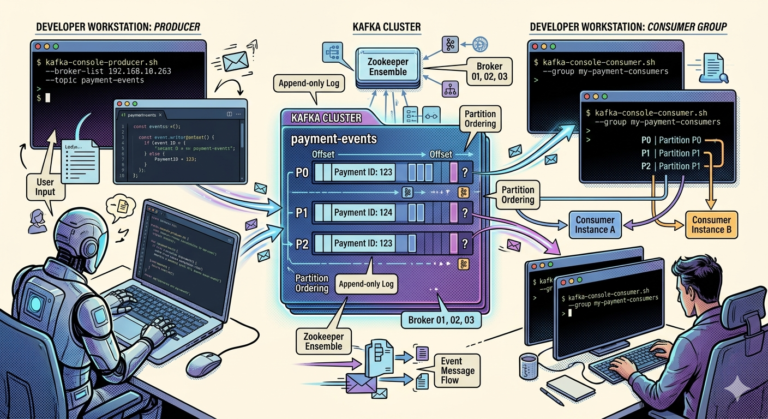
Producer → Event Broker → Consumers
The producer does not wait for all downstream processing to complete.
This is called asynchronous communication.
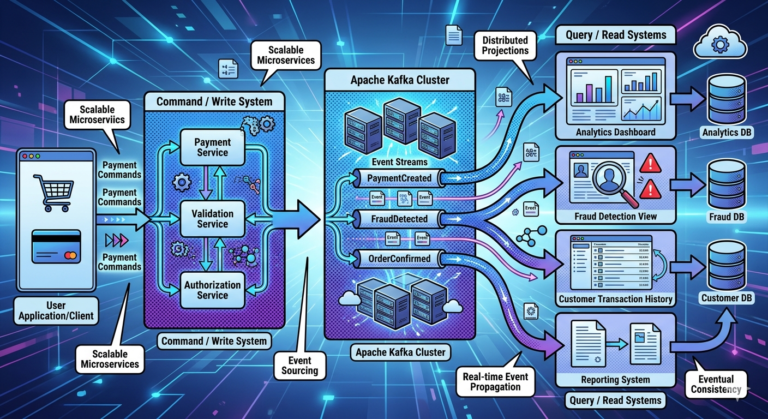
Example — Payment Processing
Instead of:
Payment Service → Fraud Service
Payment Service → Notification Service
Payment Service → Analytics Service
The flow becomes:
Payment Service
      ↓
PaymentCompleted Event
      ↓
Kafka Topic
 ├── Fraud Detection
 ├── Notification Service
 ├── Analytics Service
 └── Ledger Service
Using:
Apache Kafka
Synchronous vs Asynchronous Communication
This is the core difference between the two architectures.
Request-Response = Synchronous
The caller waits.
Example:
Client waits for:
- validation
- DB updates
- fraud checks
- notifications
Latency accumulates.
If one service becomes slow, everything slows down.
Event-Driven = Asynchronous
The producer publishes an event and moves on.
Consumers process independently.
Example:
PaymentCompleted Event Published
→ Producer continues immediately
→ Consumers process in parallel
This dramatically improves responsiveness and scalability.
Architectural Comparison
1. Coupling
Request-Response
Services are tightly coupled.
Payment Service must know:
- Fraud API
- Notification API
- Analytics API
Changes in downstream systems often impact upstream systems.
Event-Driven Architecture
Services are loosely coupled.
The producer only publishes events.
Consumers subscribe independently.
This allows:
- independent deployments
- easier scaling
- isolated failures
2. Scalability
Request-Response Systems
Scaling becomes difficult when:
- request volume increases
- downstream APIs slow down
- synchronous chains grow
A single bottleneck can impact the entire system.
Event-Driven Systems
EDA naturally supports horizontal scaling.
Consumers can scale independently.
Example:
Fraud Detection Consumers:
1 → 5 → 20
Without changing producers.
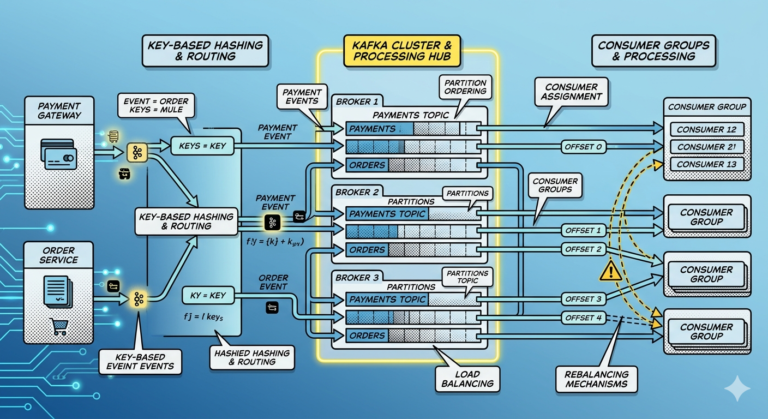
Kafka partitions enable massive parallelism.
3. Failure Handling
Request-Response
If a downstream service fails:
Fraud Service Down
→ Payment API Fails
→ Customer sees error
Failures propagate quickly.
Event-Driven Architecture
Events remain stored in the broker.
Consumers can recover later.
Example:
- Notification service crashes
- Kafka retains events
- Service resumes processing later
This greatly improves resilience.
4. Real-Time Processing
Request-Response
Not ideal for:
- continuous event streams
- analytics pipelines
- IoT telemetry
- fraud detection
- real-time dashboards
Event-Driven Architecture
EDA is specifically designed for:
- streaming systems
- live analytics
- real-time processing
- asynchronous workflows
5. Performance Characteristics
Request-Response
Performance depends heavily on:
- network latency
- downstream services
- API responsiveness
As call chains grow, latency increases.
Event-Driven Systems
EDA improves throughput by:
- decoupling processing
- parallelizing workloads
- enabling asynchronous execution
Kafka can process millions of events per second.
6. Complexity
Request-Response
Easier to:
- understand
- debug
- trace
- implement initially
Especially for smaller applications.
Event-Driven Architecture
EDA introduces additional complexity:
- event ordering
- duplicate handling
- eventual consistency
- distributed tracing
- schema evolution
It requires stronger engineering maturity.
Understanding Eventual Consistency
One major conceptual difference in EDA is eventual consistency.
In request-response systems:
Action → Immediate Consistent State
In EDA:
Action → Event Published
→ Systems Update Gradually
Different services may become consistent at slightly different times.
This is acceptable in many large-scale distributed systems.
Real-World Analogy
Request-Response = Phone Call
You call someone.
You wait until:
- they answer
- conversation completes
Communication is direct and synchronous.
Event-Driven Architecture = Radio Broadcast
A station broadcasts information.
Listeners:
- subscribe independently
- receive asynchronously
- process independently
The broadcaster does not wait for listeners.
Real-World Use Cases
Best Use Cases for Request-Response
1. CRUD Applications
Examples:
- HR systems
- admin portals
- CMS platforms
2. User Authentication
Login systems require immediate validation.
3. Small Monolithic Applications
Simple architectures benefit from request-response simplicity.
4. Interactive APIs
Applications requiring immediate responses:
- booking systems
- checkout systems
- search APIs
Best Use Cases for Event-Driven Architecture
1. Payment Systems
Every payment generates:
- ledger updates
- fraud checks
- notifications
- analytics
Perfect for events.
2. Fraud Detection
Real-time streaming analysis requires asynchronous processing.
3. IoT Systems
Millions of sensors continuously generate events.
4. Real-Time Analytics
EDA enables live dashboards and streaming metrics.
5. Microservices Architectures
Microservices benefit heavily from loose coupling.
Hybrid Architectures — The Real Industry Standard
Most modern systems do not choose only one architecture.
They combine both.
Typical Hybrid Example
Frontend
   ↓
REST API
   ↓
Payment Service
   ↓
Publishes Events to Kafka
   ↓
Fraud / Notifications / Analytics
The API layer remains synchronous.
Backend workflows become event-driven.
This provides:
- good user experience
- scalable backend processing
- resilience
- asynchronous extensibility
This hybrid model is extremely common in fintech and e-commerce systems.
Why Kafka Became Central to EDA
Apache Kafka became popular because it provides:
- durable event storage
- partitioned scalability
- high throughput
- consumer independence
- replay capability
- fault tolerance
Kafka effectively acts as:
- messaging system
- event store
- distributed log
- streaming backbone
for modern architectures.
Decision Framework — Which One Should You Use?
Use Request-Response When
Choose request-response if:
- the system is relatively simple
- immediate responses are required
- workflows are short
- scalability demands are moderate
- debugging simplicity matters
Use Event-Driven Architecture When
Choose EDA if:
- systems must scale massively
- workflows are asynchronous
- services should remain independent
- real-time streaming is important
- resilience is critical
- many systems react to the same event
Use Both Together When
This is usually the best option.
Use:
- APIs for client interaction
- events for backend workflows
This combines:
- responsiveness
- scalability
- resilience
- operational flexibility
Key Takeaways
Request-response architecture:
- is simple
- synchronous
- tightly coupled
- easy to debug
- ideal for smaller workflows
Event-Driven Architecture:
- is asynchronous
- loosely coupled
- scalable
- resilient
- ideal for distributed real-time systems
Modern large-scale systems often combine both approaches to achieve the best balance.
And technologies like:
Apache Kafka
have made large-scale event-driven systems practical and reliable.