Understanding Events in Distributed Systems
The Building Blocks of Event-Driven Architecture
In Event-Driven Architecture (EDA), everything revolves around one fundamental concept:
The event.
Whether it is:
- a payment being completed,
- an order being placed,
- a fraud alert being triggered,
- or a customer updating profile information,
modern distributed systems communicate by generating and reacting to events.
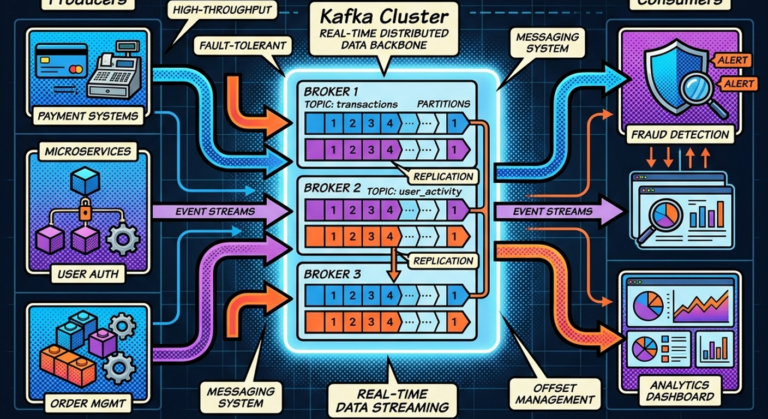
Technologies like Apache Kafka are built entirely around this concept.
But what exactly is an event?
How should events be designed?
Why are immutable events important?
What problems arise when millions of events flow across distributed systems?
In this article, we will explore:
- what an event really is
- event structure and metadata
- business events vs technical events
- immutable event design
- event schemas
- event ordering challenges
- event versioning
- real-world event examples
This article forms the conceptual foundation for understanding Kafka topics, partitions, and event streaming.
What is an Event?
An event represents:
A fact that something happened.
An event captures a change, occurrence, or action within a system.
Examples:
OrderPlaced
PaymentCompleted
UserRegistered
FraudDetected
InventoryUpdated
An event is not a command.
It is not:
“Do this”
Instead, it is:
“This happened”
This distinction is extremely important in distributed systems.
Real-World Analogy
Imagine a bank ATM transaction.
When a customer withdraws money:
- the account balance changes
- the ledger updates
- fraud systems analyze behavior
- SMS notifications are triggered
- analytics systems record metrics
The withdrawal itself becomes an event.
Example:
CashWithdrawn
Multiple independent systems react to that event.
Events are Immutable Facts
One of the most important principles in EDA:
Events should be immutable.
Once an event is published:
- it should never change
- it should never be edited
- it should represent historical truth
Why Immutability Matters
Immutability provides:
- auditability
- traceability
- consistency
- replay capability
- debugging support
For example:
{
  "eventType": "PaymentCompleted",
  "transactionId": "TXN1001",
  "amount": 2500
}
If this event changes later:
- audit trails become unreliable
- consumers become inconsistent
- debugging becomes difficult
Immutable events preserve system history.
Event Structure
Events are usually represented as structured messages.
Typically JSON, Avro, or Protobuf.
A well-designed event contains:
- event metadata
- business payload
- timestamps
- identifiers
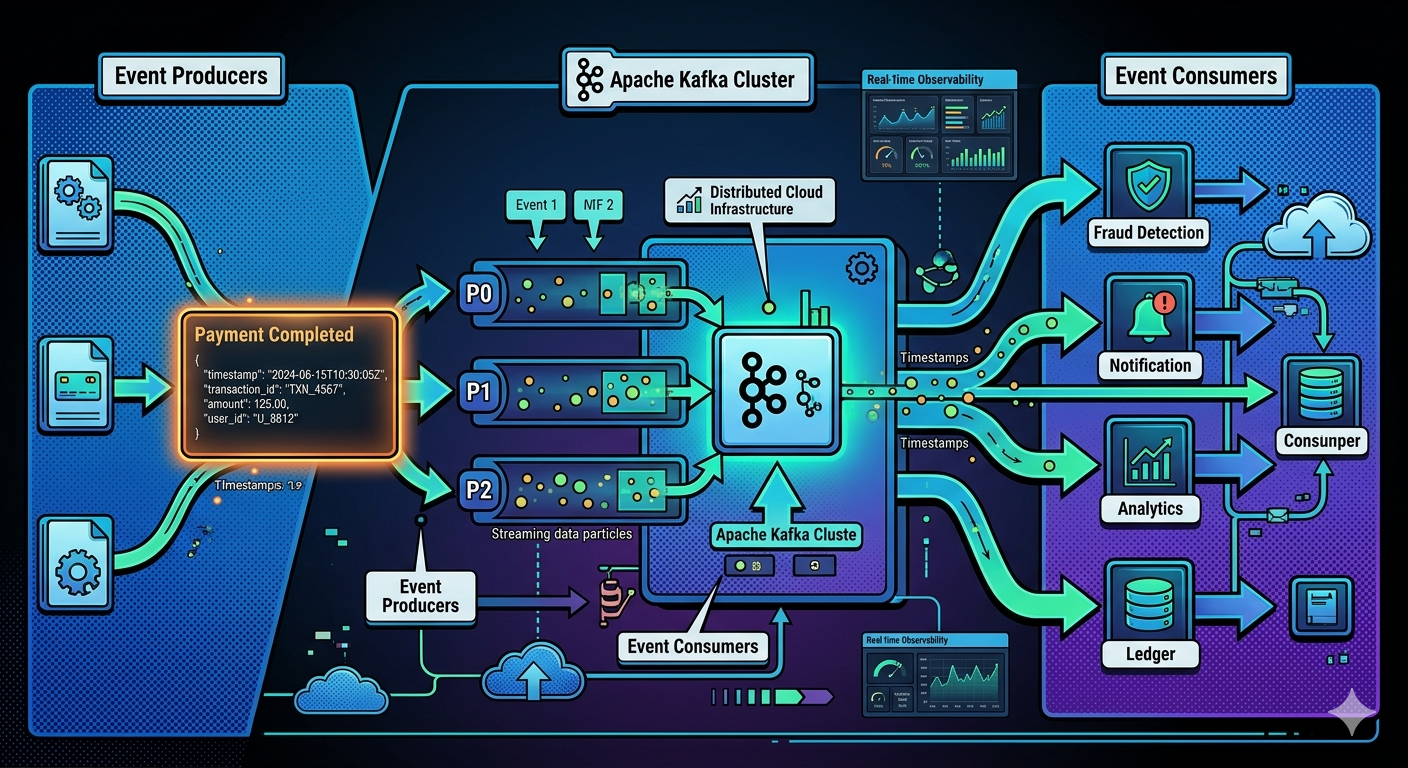
Basic Event Example
{
  "eventId": "evt-9012",
  "eventType": "PaymentCompleted",
  "timestamp": "2026-05-25T10:30:00Z",
  "source": "payment-service",
  "data": {
    "transactionId": "TXN10293",
    "customerId": "CUST100",
    "amount": 2500,
    "currency": "INR"
  }
}
Understanding Event Metadata
Metadata describes the event itself.
Common metadata fields include:
| Field | Purpose |
|---|---|
| eventId | Unique identifier |
| eventType | Type of event |
| timestamp | When event occurred |
| source | Originating service |
| version | Schema version |
| correlationId | Tracks workflow chain |
Why Metadata is Important
Metadata enables:
- observability
- debugging
- tracing
- replaying events
- correlating workflows
For example:
- payment event triggers fraud check
- fraud check triggers alert
- alert triggers case creation
A shared correlation ID links the entire workflow.
Business Events vs Technical Events
Not all events are the same.
Events usually fall into two major categories.
1. Business Events
These represent meaningful business activities.
Examples:
OrderPlaced
PaymentCompleted
RefundIssued
CustomerRegistered
Business events are:
- domain-oriented
- stable
- meaningful to multiple systems
These are the most important events in EDA.
2. Technical Events
These represent system-level activities.
Examples:
CacheRefreshed
ServiceStarted
ConnectionTimeout
RetryAttempted
Technical events help with:
- monitoring
- debugging
- observability
- infrastructure operations
Event Naming Best Practices
Good event names are:
- descriptive
- business-oriented
- past tense
Good examples:
PaymentCompleted
OrderCancelled
InvoiceGenerated
Poor examples:
ProcessPayment
UpdateInventory
HandleRefund
These sound like commands rather than facts.
Events Represent State Changes
An event often indicates that system state changed.
Example:
Before:
Order Status = Pending
Event occurs:
OrderConfirmed
After:
Order Status = Confirmed
Events become a historical log of system transitions.
Event Streams
In systems like:
Apache Kafka
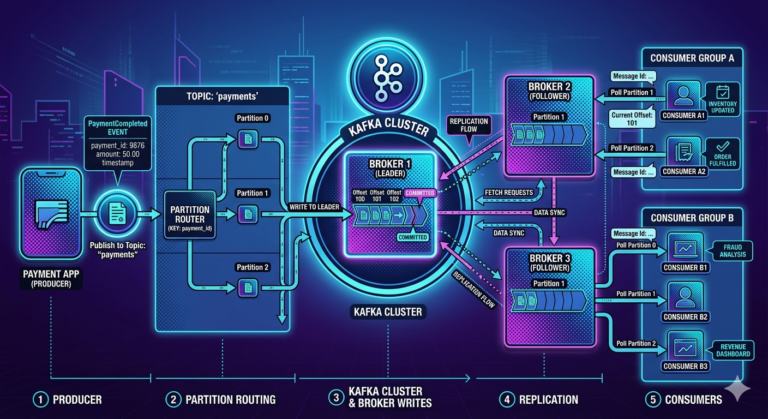
events are continuously appended into streams.
Example stream:
OrderPlaced
PaymentCompleted
InventoryReserved
ShipmentCreated
DeliveryCompleted
These streams form a chronological sequence of business activity.
Why Event Streams are Powerful
Event streams enable:
- real-time analytics
- replayability
- auditing
- state reconstruction
- stream processing
Instead of storing only current state, systems preserve history.
Event Ordering Challenges
Distributed systems introduce one major challenge:
Events may not always arrive in order.
Example:
PaymentCompleted
PaymentRefunded
What if:
Refund arrives before payment?
This can happen due to:
- network latency
- retries
- distributed partitions
- asynchronous processing
Why Ordering Matters
Incorrect ordering can cause:
- invalid balances
- duplicate processing
- inconsistent analytics
- corrupted workflows
Ordering becomes a critical architectural concern.
How Kafka Helps with Ordering
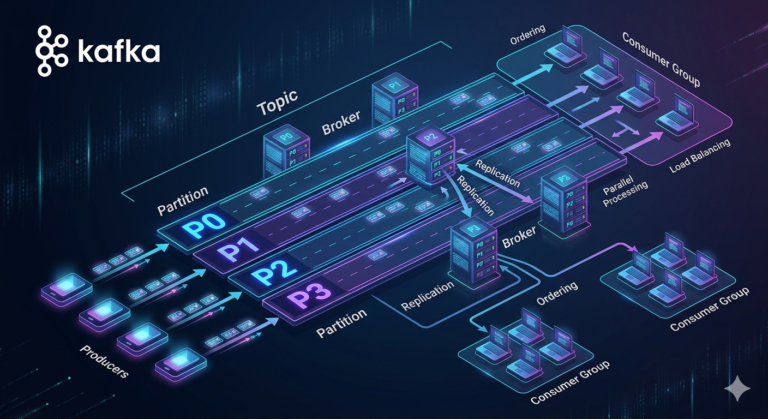
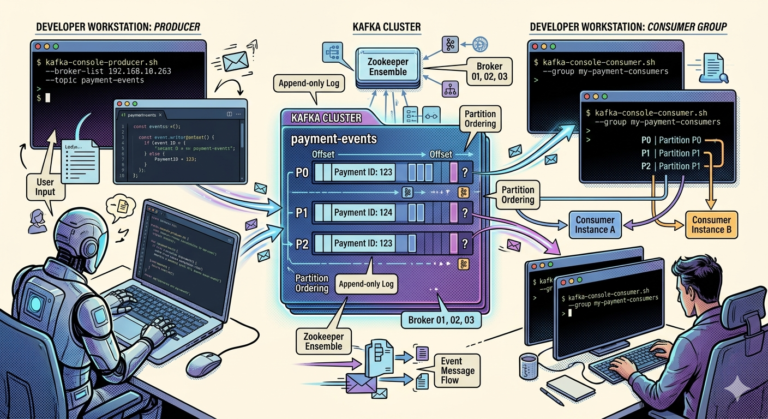
Apache Kafka preserves ordering:
- within a partition
- for events sharing the same key
Example:
Customer ID = same partition
This allows deterministic event processing.
We will explore this deeply in upcoming articles on partitions and offsets.
Event Duplication in Distributed Systems
Another important reality:
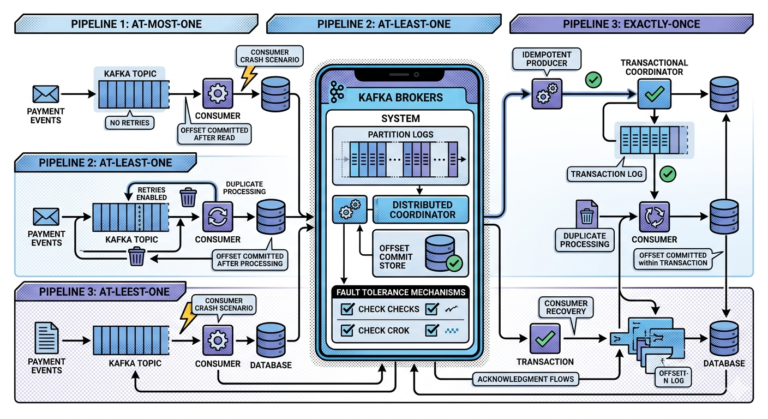
Distributed systems may deliver duplicate events.
Example:
PaymentCompleted delivered twice
Why?
- retries
- network failures
- consumer restarts
- broker failovers
Consumers must often be:
- idempotent
- duplicate-safe
Event Schema Design
An event schema defines:
- event structure
- field types
- required attributes
Example schema:
{
  "eventType": "PaymentCompleted",
  "transactionId": "string",
  "amount": "number",
  "currency": "string"
}
Schemas ensure consistency across producers and consumers.
Why Schema Management Matters
Without schemas:
- producers may send incompatible data
- consumers may break unexpectedly
- integrations become fragile
As systems grow, schema governance becomes essential.
Schema Evolution
Events evolve over time.
Example:
Version 1:
{
  "transactionId": "TXN100"
}
Version 2:
{
  "transactionId": "TXN100",
  "paymentMethod": "UPI"
}
Consumers must handle both versions safely.
This is called:
Schema evolution.
Event Granularity
Another important design question:
How much information should an event contain?
Fine-Grained Events
Example:
ItemAddedToCart
CartUpdated
CouponApplied
Advantages:
- flexibility
- detailed auditing
Disadvantages:
- higher event volume
- more processing complexity
Coarse-Grained Events
Example:
CheckoutCompleted
Advantages:
- simplicity
- fewer events
Disadvantages:
- reduced detail
- less replay precision
Good architectures balance both approaches carefully.
Event Replay
One major advantage of Kafka-based systems:
Events can be replayed.
Example:
- analytics service crashes
- restart consumer
- replay historical events
This is extremely valuable for:
- recovery
- debugging
- rebuilding projections
- machine learning pipelines
Traditional systems often cannot do this easily.
Event-Driven Systems are Historical Systems
Traditional CRUD systems focus on:
Current State
Event-driven systems focus on:
State Changes Over Time
This shift is fundamental.
Systems stop thinking only about:
- what data is now
and begin tracking:
- how the data became what it is
Real-World Example — Payment Event Lifecycle
Imagine an online payment.
Step 1 — User Pays
Event generated:
PaymentInitiated
Step 2 — Bank Confirms
Event generated:
PaymentCompleted
Step 3 — Fraud Engine Reacts
Event generated:
FraudCheckPassed
Step 4 — Notification Sent
Event generated:
NotificationDelivered
Each step becomes part of the system’s event history.
Why Events are the Foundation of Modern Systems
Modern platforms rely heavily on event streams because they enable:
- scalability
- loose coupling
- resilience
- real-time analytics
- distributed processing
- asynchronous workflows
This is why technologies like:
Apache Kafka
have become central to modern architectures.
Key Takeaways
An event:
- represents something that happened
- is immutable
- contains structured information
- enables asynchronous communication
Good event design requires understanding:
- metadata
- schemas
- ordering
- duplication
- versioning
- granularity
Event streams form the backbone of modern distributed systems and enable scalable event-driven architectures.