Kafka Ecosystem Overview
Understanding the Tools That Make Kafka a Complete Streaming Platform
When most beginners first encounter:
Apache Kafka
they often think only about:
- producers
- consumers
- topics
- brokers
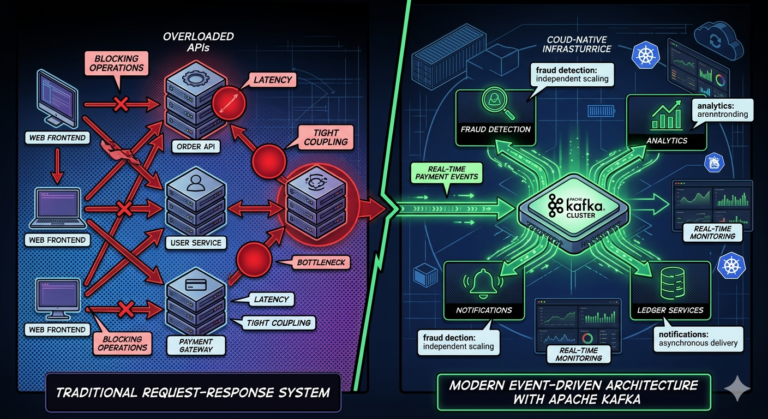
But Kafka evolved far beyond a simple messaging system.
Today, Kafka is:
An entire event streaming ecosystem.
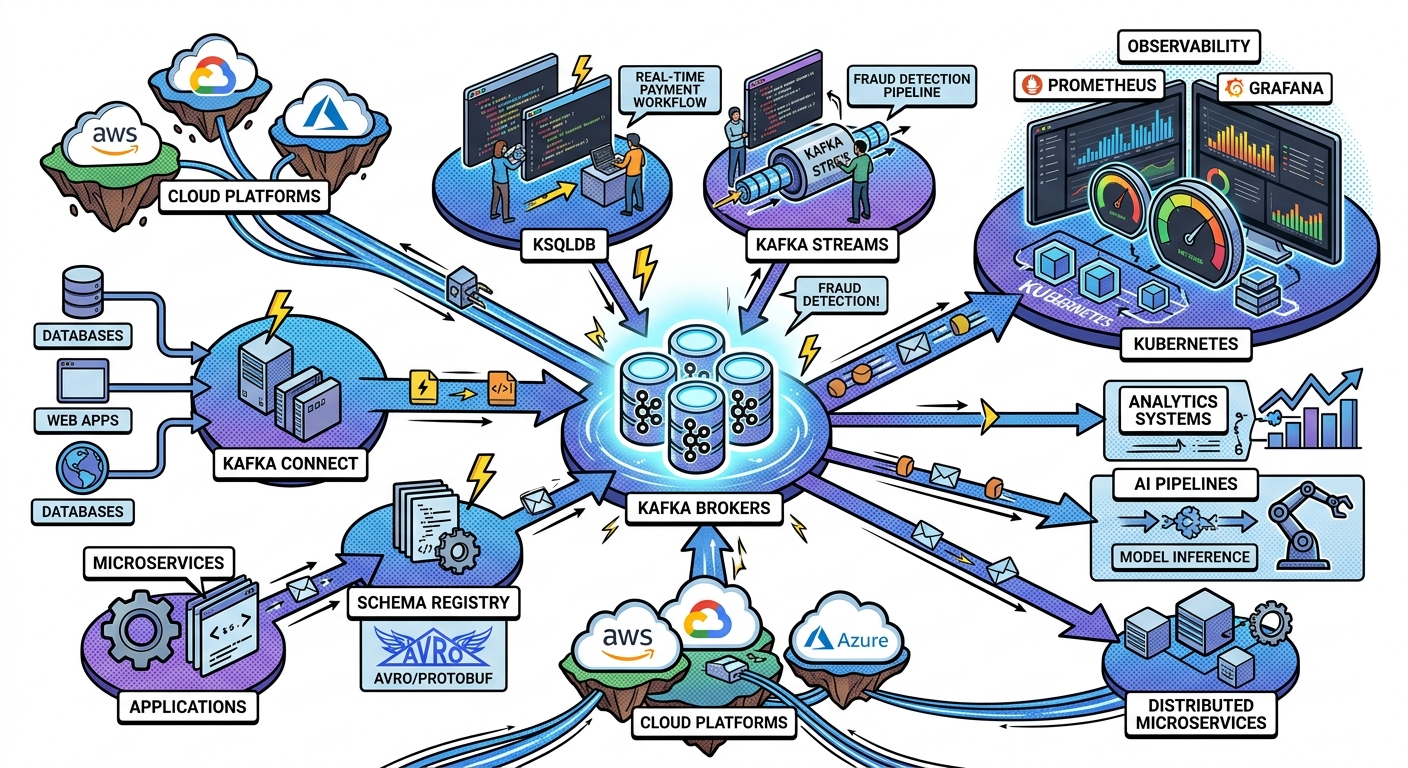
Modern Kafka deployments often include:
- stream processing engines
- data integration frameworks
- schema management
- monitoring systems
- cluster management tools
- cloud-native infrastructure
- SQL streaming platforms
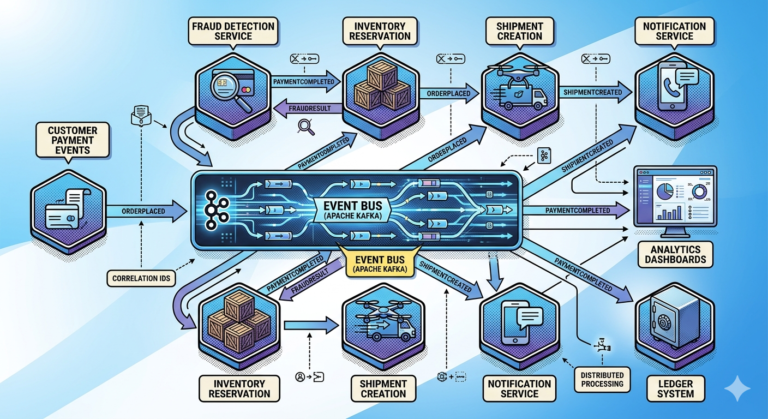
Together, these components enable organizations to build:
- real-time analytics
- event-driven architectures
- distributed workflows
- streaming data platforms
- enterprise integration pipelines
In this article, we will explore:
- the major components of the Kafka ecosystem
- what each tool does
- how they work together
- real-world architectural roles
- why Kafka became a full streaming platform
This article serves as a roadmap for the advanced Kafka ecosystem.
Why Kafka Needed an Ecosystem
Initially, Kafka focused mainly on:
- event storage
- distributed messaging
- scalable event streaming
But organizations quickly needed additional capabilities:
Examples:
- database integration
- stream processing
- schema management
- observability
- SQL querying
- cloud deployment
- operational tooling
This led to the growth of the Kafka ecosystem.
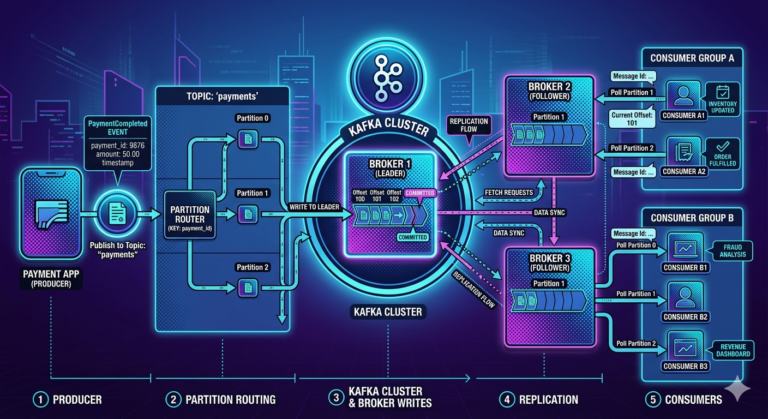
High-Level Kafka Ecosystem
A simplified ecosystem view:
Applications
   ↓
Kafka Producers
   ↓
Kafka Cluster
   ↓
Kafka Consumers
   ↓
Streaming / Analytics / Integrations
Around Kafka, additional tools provide:
- processing
- integration
- governance
- observability
Core Kafka Components
The ecosystem revolves around:
| Component | Purpose |
|---|---|
| Kafka Brokers | Event storage and streaming |
| Producers | Publish events |
| Consumers | Consume events |
| Topics & Partitions | Organize scalable event streams |
These form the foundational streaming layer.
Kafka Connect
One of the most important ecosystem tools is:
Kafka Connect
Kafka Connect simplifies:
Data integration between Kafka and external systems.
Why Kafka Connect Exists
Without Kafka Connect:
- developers must write custom integration code
Examples:
- database connectors
- Elasticsearch sync
- cloud storage pipelines
- JDBC integrations
This becomes repetitive and operationally expensive.
What Kafka Connect Provides
Kafka Connect provides:
- reusable connectors
- scalable ingestion pipelines
- fault-tolerant integrations
- distributed connector execution
Source Connectors
Source connectors move data:
Into Kafka.
Examples:
MySQL → Kafka
PostgreSQL → Kafka
MongoDB → Kafka
Sink Connectors
Sink connectors move data:
Out of Kafka.
Examples:
Kafka → Elasticsearch
Kafka → S3
Kafka → Snowflake
Real-World Example
Suppose payment events stream into Kafka.
Kafka Connect can automatically send events to:
- data warehouses
- analytics systems
- search indexes
without writing custom applications.
Why Kafka Connect Became Popular
Kafka Connect provides:
- standardized integration
- scalability
- operational simplicity
- connector ecosystem reuse
This dramatically accelerates enterprise adoption.
Kafka Streams
Another major ecosystem component is:
Kafka Streams
Kafka Streams enables:
Real-time stream processing directly inside applications.
What is Stream Processing?
Stream processing means:
- continuously processing events as they arrive
Examples:
- fraud detection
- aggregations
- filtering
- transformations
- anomaly detection
Kafka Streams Workflow
Kafka Topic
   ↓
Kafka Streams Application
   ↓
Processed Output Topic
Applications process events continuously.
Real-Time Fraud Detection Example
Input stream:
PaymentCompleted
Kafka Streams application:
- analyzes transaction behavior
- computes risk scores
Outputs:
FraudAlert
in real time.
Why Kafka Streams Matters
Kafka Streams provides:
- lightweight stream processing
- embedded application architecture
- scalability through partitions
- stateful stream operations
without requiring separate large clusters.
Stateful Stream Processing
Kafka Streams supports:
- aggregations
- joins
- windows
- local state stores
This enables sophisticated streaming applications.
ksqlDB
Another important ecosystem component is:
ksqlDB
ksqlDB enables:
SQL-style stream processing on Kafka topics.
Why ksqlDB Exists
Not all teams want to write:
- Java stream processing applications
Many analysts and engineers prefer:
- SQL-based workflows
ksqlDB bridges this gap.
Example ksqlDB Query
SELECT customerId, COUNT(*)
FROM payments
WINDOW TUMBLING (SIZE 1 MINUTE)
GROUP BY customerId;
This continuously computes:
- live payment counts
Why Streaming SQL Matters
Streaming SQL enables:
- real-time dashboards
- operational analytics
- event filtering
- stream joins
using familiar SQL syntax.
Schema Registry
Another critical ecosystem component is:
Confluent Schema Registry
Schema Registry manages:
Event schemas and compatibility.
Why Schema Management Matters
Event formats evolve over time.
Example:
PaymentCompleted v1
PaymentCompleted v2
Without governance:
- consumers break
- compatibility issues occur
What Schema Registry Provides
Schema Registry enables:
- centralized schema storage
- versioning
- compatibility validation
- contract enforcement
Critical in large organizations.
Supported Serialization Formats
Common formats:
- Avro
- Protobuf
- JSON Schema
These improve:
- efficiency
- compatibility
- governance
Why Schemas Matter in Event-Driven Systems
Kafka systems often contain:
- hundreds of services
- thousands of event types
Schema governance becomes essential for:
- operational stability
- long-term maintainability
Kafka Monitoring Ecosystem
Kafka requires strong observability.
Important monitoring tools include:
- Grafana
- Prometheus
- AKHQ
- Kafka UI
- Control Center
Grafana and Prometheus
Grafana
and:
Prometheus
are commonly used for:
- broker metrics
- consumer lag
- throughput monitoring
- cluster health
Kafka UI Tools
Popular UI tools include:
- AKHQ
- Kafka UI
These help visualize:
- topics
- partitions
- consumer groups
- offsets
- lag
Why Operational Visibility Matters
Kafka clusters process:
- massive real-time traffic
Observability is critical for:
- reliability
- debugging
- scaling
- incident response
MirrorMaker
Kafka also includes:
Apache Kafka MirrorMaker
used for:
Cross-cluster replication.
MirrorMaker Use Cases
Examples:
- disaster recovery
- multi-region replication
- cloud migration
- hybrid architectures
MirrorMaker replicates topics between Kafka clusters.
Kafka and Kubernetes
Modern Kafka deployments increasingly run on:
Kubernetes
using operators like:
- Strimzi
- Confluent Operator
Why Kubernetes Matters
Kubernetes enables:
- automated scaling
- container orchestration
- rolling upgrades
- infrastructure automation
Kafka became deeply integrated into cloud-native ecosystems.
Kafka Cloud Platforms
Managed Kafka services include:
- Confluent Cloud
- Amazon MSK
- Azure Event Hubs
- Aiven Kafka
These reduce:
- operational overhead
- infrastructure management burden
Why Managed Kafka Became Popular
Operating Kafka clusters at scale can be complex.
Managed platforms simplify:
- upgrades
- monitoring
- replication
- security
- scaling
Kafka Security Ecosystem
Enterprise Kafka deployments often include:
- SSL/TLS encryption
- SASL authentication
- RBAC authorization
- audit logging
Security becomes critical for:
- banking
- healthcare
- compliance-heavy industries
Kafka and Data Lakes
Kafka increasingly integrates with:
- data lakes
- AI pipelines
- warehouse systems
Streaming data continuously into:
- Snowflake
- BigQuery
- S3
- Hadoop
Kafka Became More Than Messaging
Over time Kafka evolved into:
A complete streaming data platform.
The ecosystem supports:
- ingestion
- processing
- storage
- governance
- monitoring
- analytics
- integration
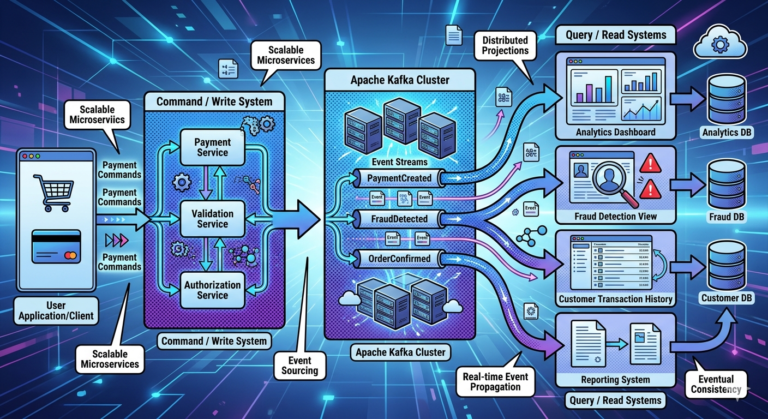
Real-World Enterprise Architecture
Large organizations often combine:
Applications
   ↓
Kafka
   ↓
Kafka Streams
   ↓
Analytics Systems
   ↓
Dashboards / AI Pipelines
alongside:
- Kafka Connect
- Schema Registry
- monitoring platforms
forming complete event-driven ecosystems.
Why the Ecosystem Matters
Kafka alone handles:
- event transport
The ecosystem enables:
- enterprise-scale streaming architectures
This ecosystem is one reason Kafka became dominant in:
- fintech
- observability
- cloud-native systems
- real-time analytics
Common Beginner Misconceptions
Misconception 1
Kafka is only brokers and topics
Kafka includes a large streaming ecosystem.
Misconception 2
Kafka Connect is mandatory
Custom integrations are still possible.
Misconception 3
Kafka Streams replaces all stream processing systems
Different stream processors serve different use cases.
Misconception 4
Schema governance is optional
Large event-driven systems require strong schema management.
Why the Kafka Ecosystem Became So Influential
The Kafka ecosystem enables organizations to build:
- real-time data platforms
- scalable event-driven systems
- streaming analytics pipelines
- distributed integration architectures
using:
Apache Kafka
as the central streaming backbone.
This ecosystem transformed Kafka from:
- a messaging technology
into:
A foundational real-time data infrastructure platform.
Key Takeaways
The Kafka ecosystem includes:
- Kafka Connect
- Kafka Streams
- ksqlDB
- Schema Registry
- monitoring platforms
- cloud-native deployment tools
Kafka Connect enables:
- scalable data integration
Kafka Streams and ksqlDB enable:
- real-time stream processing
Schema Registry provides:
- event schema governance
Monitoring platforms help manage:
- broker health
- consumer lag
- operational observability
Together, these tools transform:
Apache Kafka
into a complete ecosystem for building scalable real-time event-driven architectures.