Designing Real-Time Systems with Kafka
Building Scalable Event-Driven Architectures for Modern Applications
Modern applications increasingly operate in:
Real time.
Users today expect:
- instant notifications
- live dashboards
- immediate payments
- real-time fraud detection
- live delivery tracking
- streaming analytics
- instant recommendations
Traditional batch-oriented architectures struggle to satisfy these expectations.
This is one of the major reasons organizations increasingly adopt:
Apache Kafka
to design:
Real-time distributed systems.
Kafka enables systems to:
- react continuously to events
- process streams at scale
- coordinate asynchronous workflows
- deliver low-latency data pipelines
- scale horizontally
In this article, we will deeply explore:
- what real-time systems are
- why traditional systems struggle
- event-driven design principles
- Kafka-based real-time architectures
- scalability patterns
- low-latency workflows
- real-world examples
- architectural tradeoffs
This article connects Kafka directly to modern large-scale distributed systems design.
What is a Real-Time System?
A real-time system is one that:
Responds to events with minimal delay.
Examples:
- payment authorization
- fraud detection
- stock trading
- delivery tracking
- live analytics
- streaming recommendations
Real-time systems prioritize:
- responsiveness
- continuous processing
- low latency
Real-Time Does Not Always Mean Instant
Real-time systems usually mean:
- milliseconds
- seconds
- near-instant responsiveness
not necessarily:
- microsecond hardware-level timing
For most business systems:
- sub-second or few-second latency is considered real time.
Why Traditional Architectures Struggle
Traditional enterprise systems often rely on:
- synchronous APIs
- batch processing
- scheduled jobs
- tightly coupled workflows
Example:
Database Updates
   ↓
Nightly Batch Processing
   ↓
Reports Generated
This creates:
- stale information
- delayed reactions
- operational bottlenecks
Example — Traditional E-Commerce Analytics
Suppose customer purchases product.
Traditional analytics pipeline:
Orders Stored
   ↓
Nightly ETL Job
   ↓
Reports Generated Next Day
Business cannot react immediately.
Modern Systems Require Continuous Streaming
Modern platforms increasingly require:
Event Happens
   ↓
System Reacts Immediately
Examples:
- instant fraud blocking
- live inventory updates
- real-time recommendations
- operational dashboards
Why Kafka Fits Real-Time Systems Perfectly
Kafka was designed for:
- continuous event streaming
- distributed scalability
- low-latency pipelines
- asynchronous architectures
Kafka naturally supports:
Continuous flow-based systems.
Event-Driven Architecture as the Foundation
Real-time systems are usually:
Event-driven.
Instead of:
- periodic polling
systems react to:
- continuous event streams.
Examples:
OrderPlaced
PaymentCompleted
ShipmentCreated
UserLoggedIn
Kafka streams these events continuously.
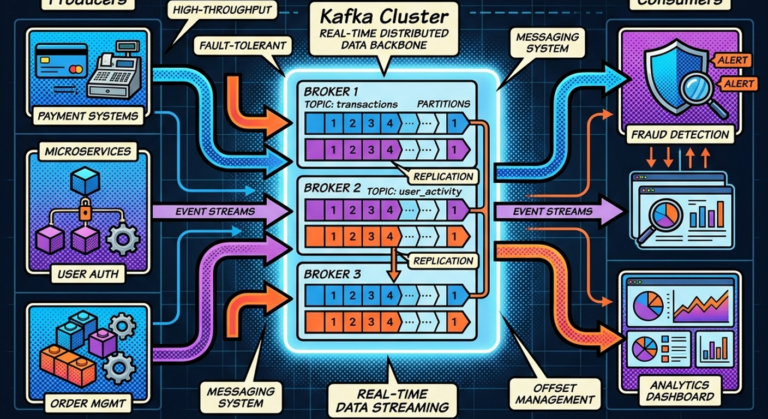
Kafka as a Real-Time Event Backbone
Many organizations use:
Apache Kafka
as:
The central nervous system for real-time events.
Applications:
- publish events
- consume streams
- react asynchronously
through Kafka topics.
High-Level Real-Time Architecture
Applications
   ↓
Kafka Topics
   ↓
Real-Time Consumers
   ↓
Dashboards / Alerts / Workflows
Everything flows continuously.
Real-Time Systems Are About Flow
Traditional systems often think in:
- requests
- transactions
- batches
Real-time systems think in:
Continuous event flows.
This is a fundamental architectural shift.
Example — Food Delivery Platform
Suppose customer places food order.
Events:
OrderPlaced
DriverAssigned
FoodPrepared
DeliveryStarted
OrderDelivered
Each event triggers:
- immediate workflows
- notifications
- dashboard updates
Kafka coordinates these flows continuously.
Real-Time Dashboards
Kafka powers dashboards that update:
- continuously
- automatically
- at scale
Examples:
- payment volume
- active deliveries
- fraud alerts
- operational metrics
Why Polling Architectures Fail at Scale
Without streaming systems:
Dashboard polls database every 30 seconds
Problems:
- database overload
- stale data
- scaling bottlenecks
Kafka enables:
- push-like streaming architectures
without expensive polling.
Real-Time Fraud Detection
Fraud systems consume:
- payment streams
- login events
- device telemetry
Kafka enables:
- sub-second fraud scoring
- continuous anomaly detection
Critical in:
- fintech
- banking
- cybersecurity
Real-Time Recommendation Systems
Streaming recommendation systems analyze:
- browsing behavior
- purchases
- clicks
- searches
Kafka continuously feeds:
- recommendation engines
- personalization systems
Example Recommendation Workflow
User Viewed Product
   ↓
Kafka Event
   ↓
Recommendation Engine
   ↓
Personalized Suggestions Updated
All in real time.
IoT and Sensor Streaming
IoT platforms generate:
- massive continuous telemetry
Examples:
- industrial sensors
- smart devices
- vehicle telemetry
- environmental monitoring
Kafka handles:
- large-scale event ingestion
- real-time monitoring pipelines
Why Kafka Scales for Streaming
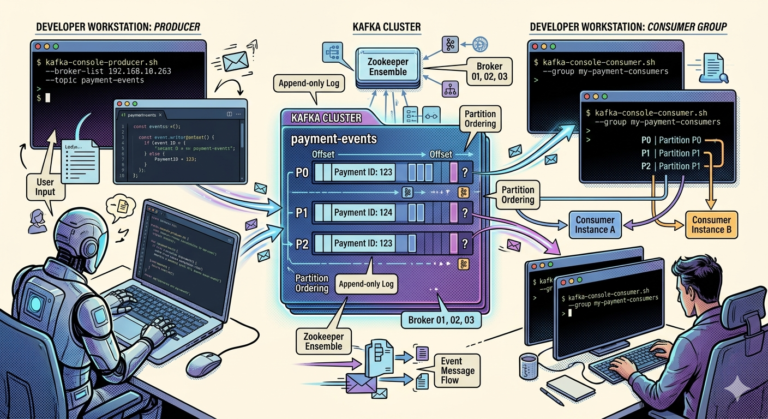
Kafka partitions topics:
sensor-data
 ├── Partition 0
 ├── Partition 1
 ├── Partition 2
Partitions distribute:
- workload
- storage
- consumers
across clusters.
This enables:
- horizontal scalability.
Consumer Groups in Real-Time Systems
Kafka consumer groups allow:
- parallel processing
Example:
Analytics Group
 ├── Consumer A
 ├── Consumer B
 └── Consumer C
Events processed concurrently.
This supports:
- massive real-time throughput.
Low-Latency Processing
Real-time systems require:
- fast event propagation
Kafka optimizes:
- sequential disk writes
- batching
- partition parallelism
- pull-based consumption
to achieve:
- high throughput with low latency.
Stream Processing in Real-Time Architectures
Real-time systems often require:
- filtering
- transformations
- aggregations
- joins
- anomaly detection
Kafka ecosystems commonly use:
Kafka Streams
or:
ksqlDB
for stream processing.
Example Stream Processing
Payment Stream
   ↓
Aggregation
   ↓
Live Revenue Dashboard
Updated continuously.
Stateful Real-Time Systems
Many real-time systems require:
Stateful processing.
Examples:
- fraud windows
- customer sessions
- inventory tracking
- recommendation history
Kafka supports:
- replayable event streams
- distributed stateful processing
Replayability in Real-Time Systems
Suppose:
- analytics bug discovered
- recommendation logic changes
Kafka allows:
- replaying historical streams
- rebuilding state
- reprocessing events
This is enormously valuable.
Eventual Consistency in Real-Time Systems
Real-time distributed systems are often:
Eventually consistent.
Meaning:
- systems synchronize asynchronously over time
This enables:
- scalability
- resilience
- distributed processing
Why Loose Coupling Matters
Real-time systems become extremely complex if services directly depend on each other.
Kafka decouples:
- producers
- consumers
through topics.
This improves:
- flexibility
- scalability
- fault isolation
Fault Tolerance in Real-Time Architectures
Failures are inevitable.
Kafka handles:
- broker failures
- consumer crashes
- retries
- replayability
without losing events.
This is critical for:
- mission-critical systems.
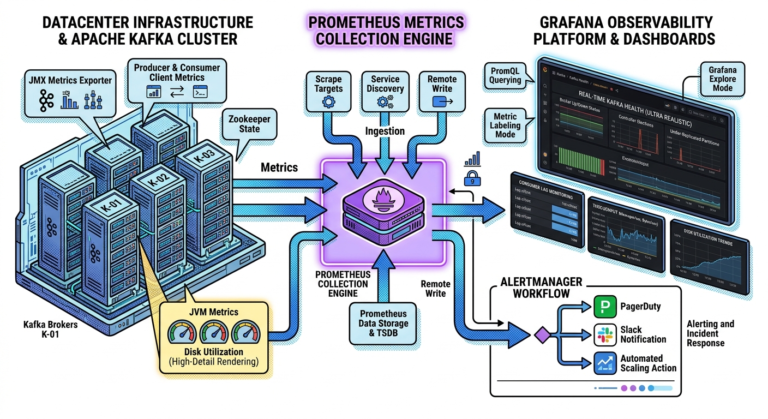
Real-Time Monitoring and Alerts
Kafka powers:
- operational monitoring
- anomaly alerts
- infrastructure telemetry
Examples:
- CPU spikes
- transaction failures
- service degradation
Kafka enables:
- continuous operational awareness.
Designing for Scalability
Real-time systems must scale horizontally.
Kafka enables scaling through:
- brokers
- partitions
- consumer groups
allowing:
- distributed parallel architectures.
Real-Time Systems Are Not Just Faster Systems
They require fundamentally different thinking:
Traditional architecture:
Store first
Process later
Real-time architecture:
Process continuously as events flow
This is a major paradigm shift.
Real-World Example — Ride Sharing
Ride-sharing platforms process:
- GPS streams
- ride requests
- pricing updates
- driver status
continuously through Kafka pipelines.
Without streaming infrastructure:
- real-time dispatch becomes difficult.
Real-World Example — Observability Platforms
Observability systems stream:
- logs
- traces
- metrics
through Kafka to power:
- dashboards
- alerts
- operational analytics
Challenges of Real-Time Systems
Real-time architectures introduce complexity.
1. Distributed Coordination
Systems become:
- highly distributed
- asynchronous
Debugging becomes harder.
2. Event Ordering
Ordering guarantees only exist:
- within Kafka partitions
Global ordering becomes difficult.
3. Replay and Idempotency
Replayable systems require:
- safe duplicate handling
Applications must often implement:
- idempotent processing.
4. Operational Complexity
Large Kafka systems require:
- monitoring
- observability
- partition planning
- capacity management
Why Kafka Became Foundational for Real-Time Systems
Modern applications increasingly require:
- continuous streaming
- distributed scalability
- asynchronous workflows
- real-time analytics
Apache Kafka
provides these capabilities extremely effectively.
This is why Kafka became foundational infrastructure for:
- fintech
- streaming analytics
- IoT
- cybersecurity
- cloud-native systems
- observability platforms
Common Beginner Misconceptions
Misconception 1
Real-time means no persistence
Kafka combines:
- real-time streaming
with: - durable storage.
Misconception 2
Kafka automatically makes systems real time
Architecture and processing logic still matter enormously.
Misconception 3
Real-time systems eliminate failures
Failures still happen constantly in distributed systems.
Misconception 4
Batch systems are obsolete
Many organizations combine:
- batch analytics
- streaming architectures
together.
Key Takeaways
Real-time systems process:
- continuous event streams
- with low latency
- at massive scale
Kafka enables:
- scalable event streaming
- asynchronous workflows
- replayable architectures
- distributed processing
- real-time analytics
Kafka topics act as:
- continuous event pipelines
connecting:
- producers
- stream processors
- analytics systems
- dashboards
- operational workflows
These capabilities make:
Apache Kafka
one of the most important technologies powering modern real-time distributed systems.